
The Outer Worlds 2 is Obsidian trying to rediscover the role-playing magic that once defined it as a juggernaut within the genre.
And in a lot of ways, this bigger, and generally better sequel accomplishes its goals. Compared to The Outer Worlds — and indeed, compared to many other modern RPGs — the game provides player choice and consequence in abundance, often to an impressive extent.
Between building your own character, allying with various factions, and getting to shape the perspectives of your party members, The Outer Worlds 2 has plenty going for it on a mechanical level. And by the end of its 50-hour campaign, you'll come to appreciate how key decisions begin to stack on top of one another.
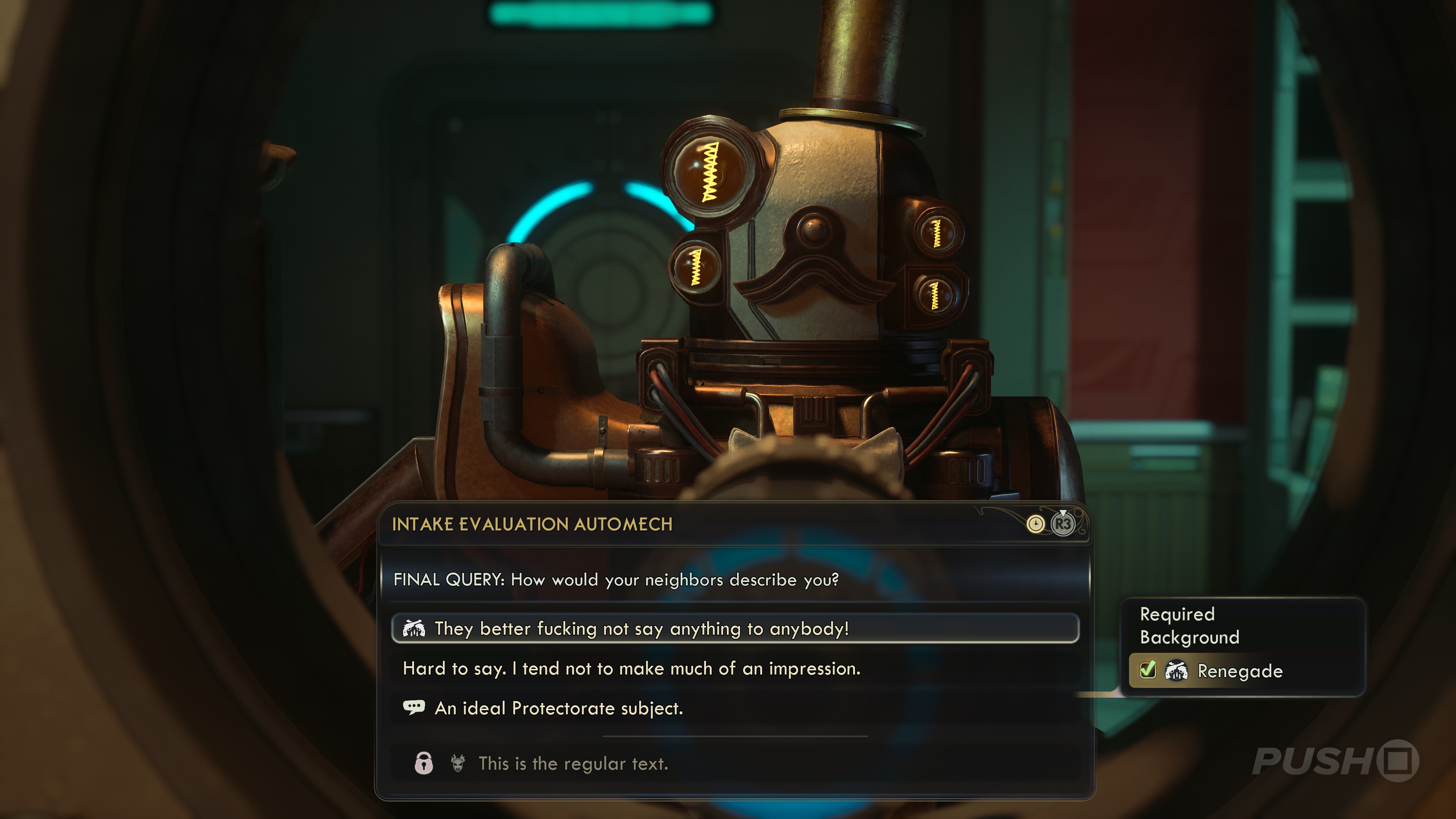
Everyone's going to play this game a bit differently. Skill checks are rampant throughout, locking off dialogue options or object interactions unless you've chosen to invest in certain specialisations.
And then your character's morality is layered over that; you certainly don't have to play the hero, leading to loads of moments where you at least consider resorting to unfettered violence in order to satisfy your objectives.
Quests always feel like they're branching, and conversations are always throwing curveballs that'll tempt you into responses that you may have previously ignored. What we're saying is that The Outer Worlds 2 is, at its best, a very engaging RPG — and more often than not, it'll really make you think about your next move.
There's a problem, however, and it's one that's unfortunately baked into the series' identity.
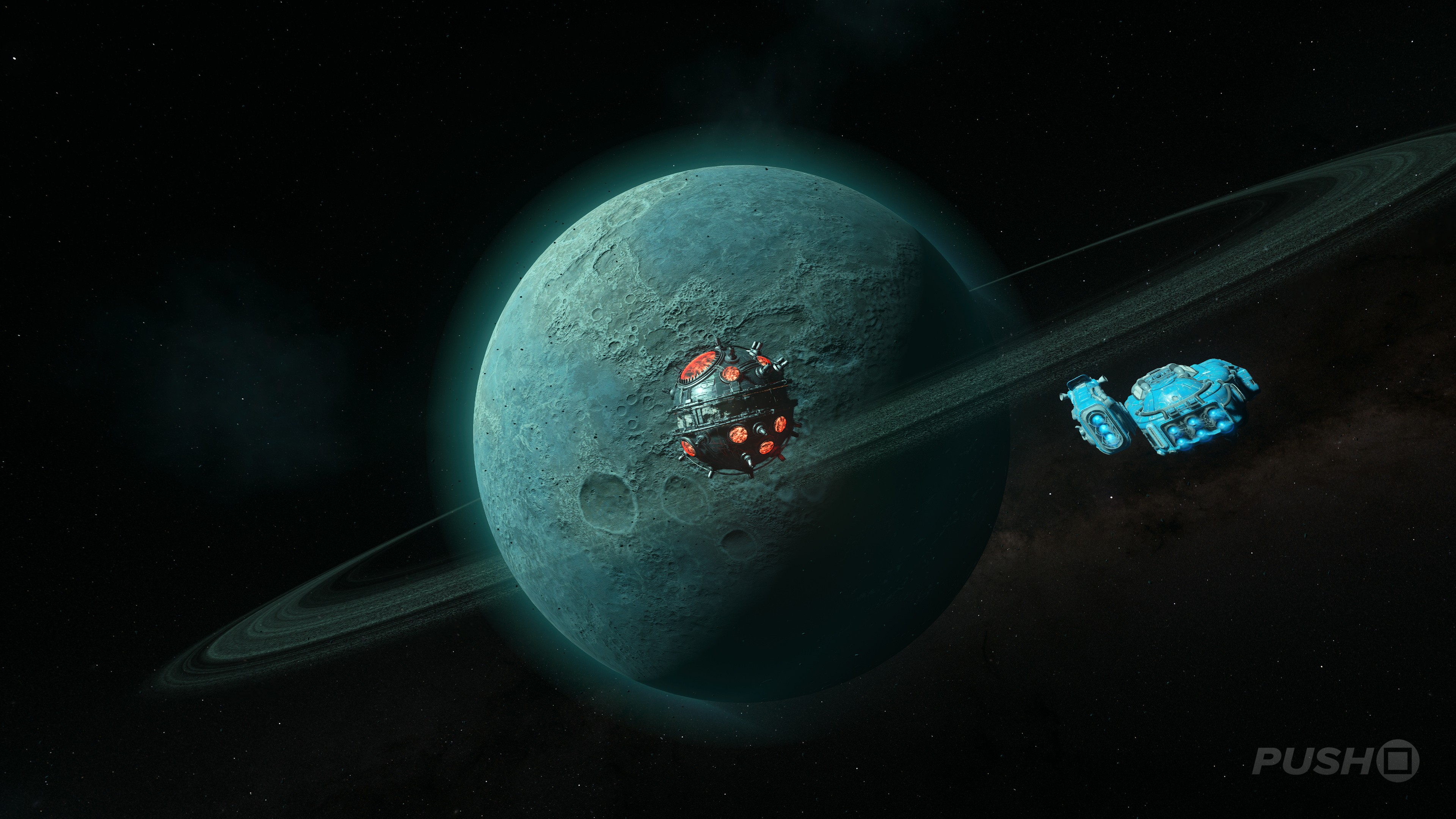
The Outer Worlds' sci-fi setting is dystopian, but comically so. Cut off from Earth, colonies are either ruled over by blatantly evil corporations or morally questionable, cult-like organisations. In this game's solar system of Arcadia, there's a war going on between two such entities.
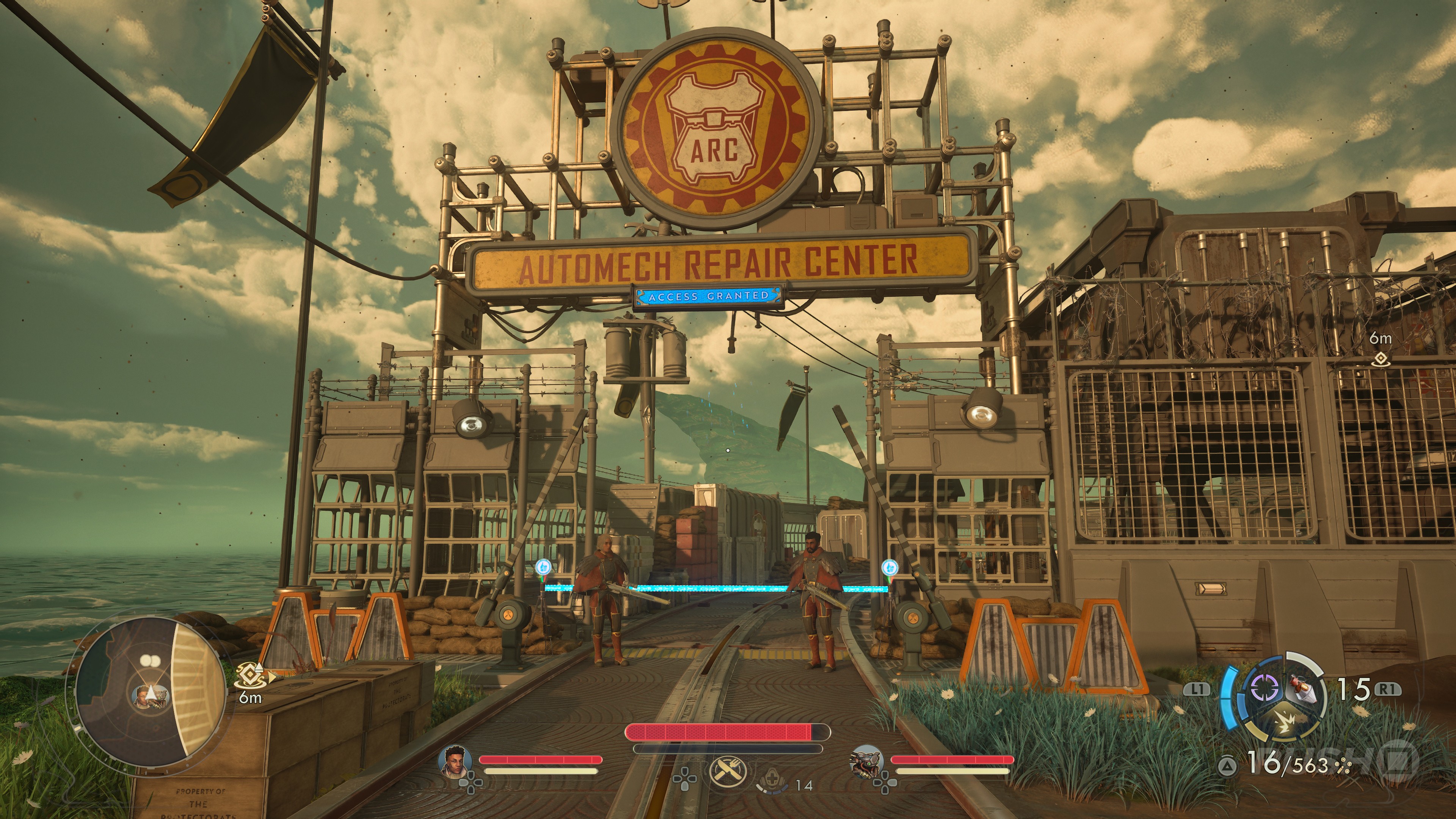
Both the hyper-capitalist Auntie's Choice and the mathematically obsessed The Order have clear flaws in terms of beliefs and societal structure — and that should make them interesting to explore from a player perspective. There are no objectively good and bad choices here.
But The Outer Worlds' world building is so heavy on over-the-top parody that the title's ironic tone can undermine the emotion that it's trying to convey. This sequel doesn't necessarily want to be a serious RPG that deals with serious issues, but it's still difficult to truly care about the game's factions when they're all so sardonic.
And this criticism extends to the people who inhabit said factions. Outside of a few key figures, we'd struggle to name any characters who make a lasting impression; so many of them are just extensions of their faction's viewpoint, offering little reason to care about them as individuals, or the mess that they usually find themselves in.
As a result, interacting with the vast majority of characters in The Outer Worlds 2 is just a bit... dull. This is an intelligent, well written, and sometimes genuinely funny game — as you'd expect of Obsidian — but there's a frustrating lack of personality beyond the surface-level satire.
Sadly, your party members suffer the same fate. Playing as a fully customisable lead known simply as the Commander, your top secret mission goes horribly wrong in the game's prologue, and you spend the rest of the adventure attempting to put things right.
As you progress, you can recruit a number of ragtag allies to your system-saving cause. And we use the word 'can' for a reason; you don't have to recruit anyone, and it's even possible to just completely miss a potential party member based on your actions.
Anyway, these allies — or possible partners in crime — are disappointingly hit and miss. Some have enjoyable quirks but they're never quite fleshed out enough, while others fall into the same trap as most of the game's NPCs. That is to say, they end up being little more than a one-note mouthpiece for their faction's ideals.
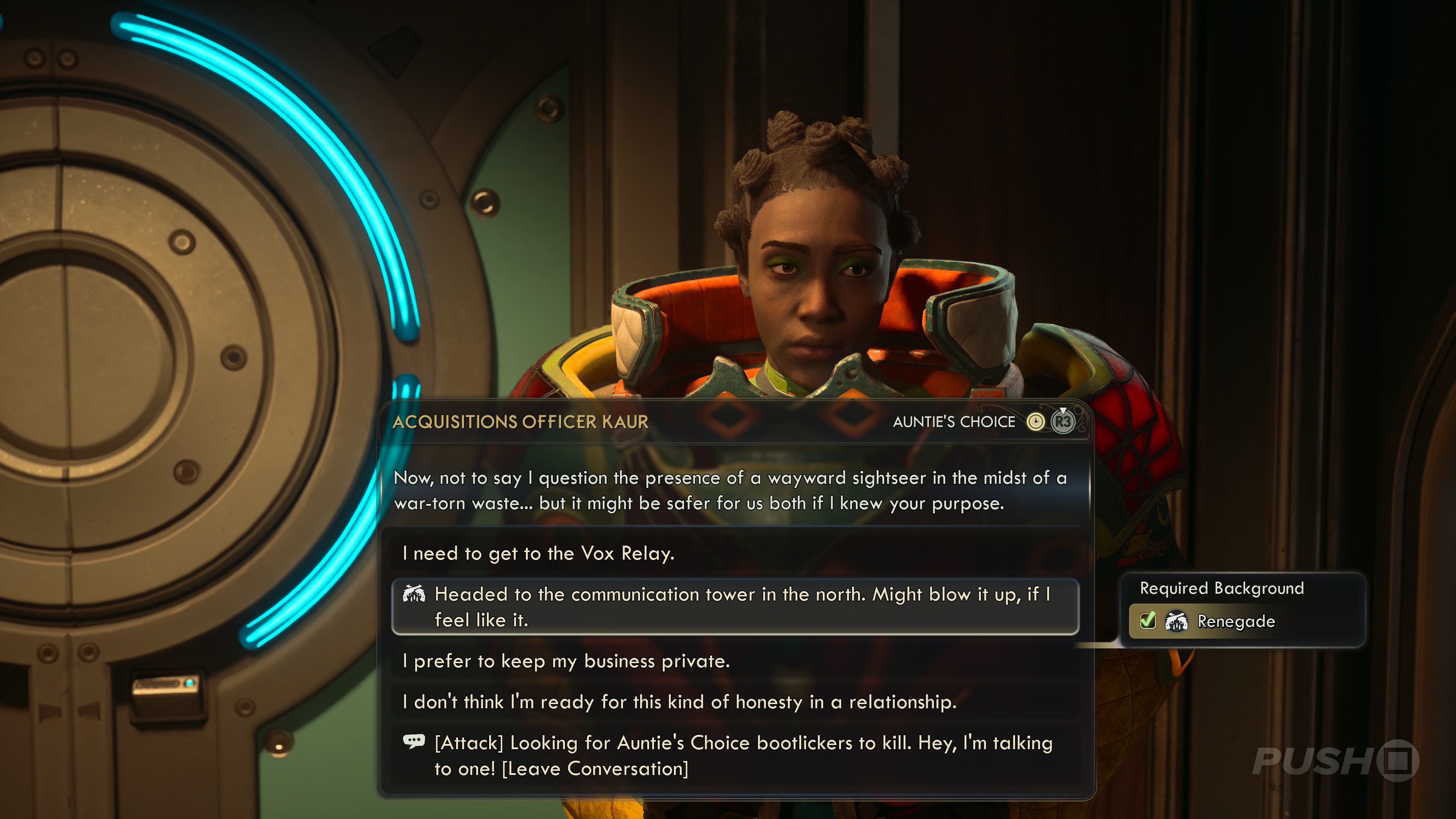
But to be fair, party member-specific quests do let you explore — and in some cases alter — the mindset of your companions. Again, it's the role-playing aspects that carry this part of the game; you may not be totally endeared to these characters, but being able to have a noticeable impact on their development adds welcome spice to each relationship.
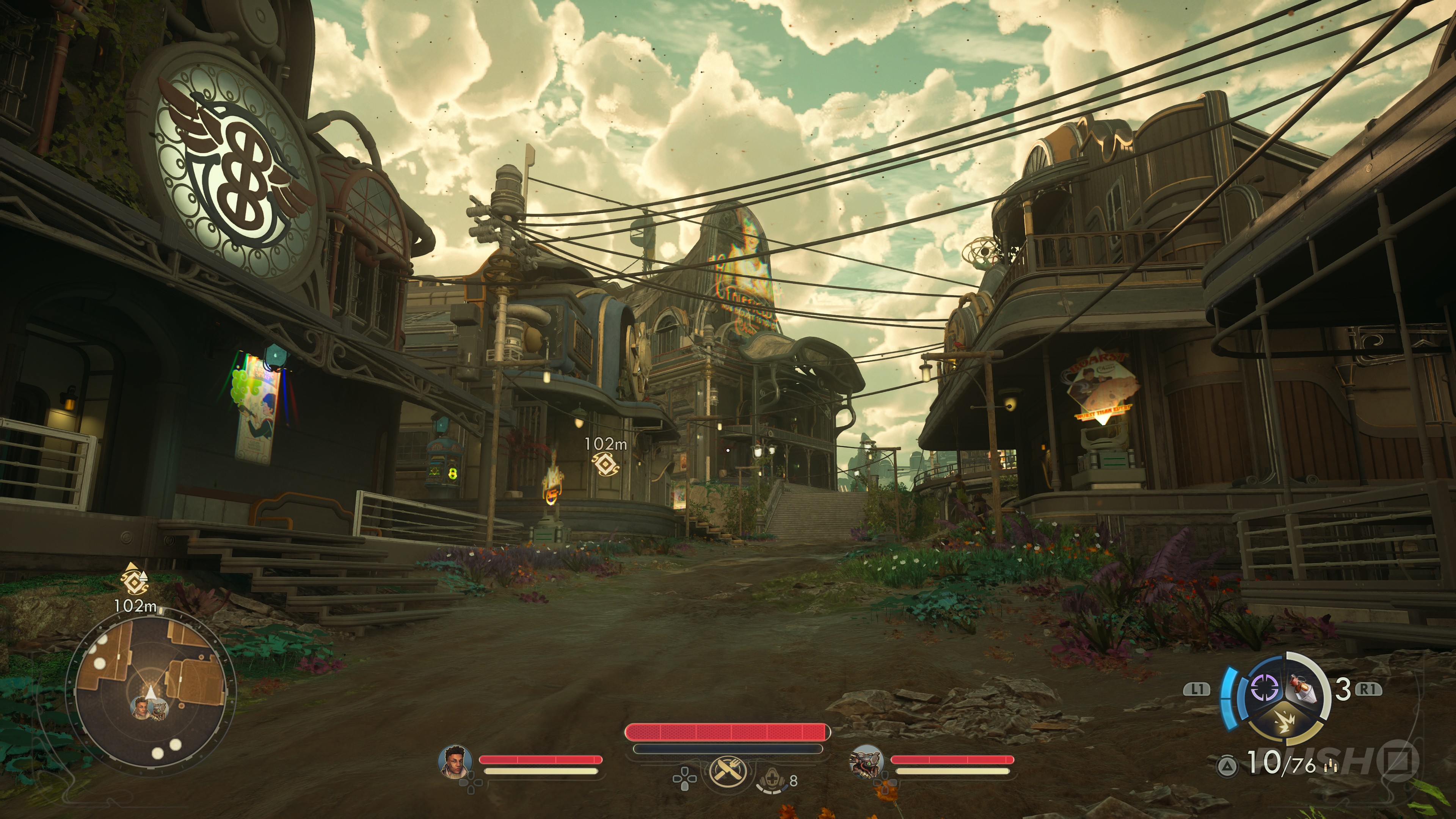
Beyond the seemingly endless flow of dialogue options, The Outer Worlds 2 is a much bigger release than its predecessor. The game is built around a handful of colonised planets, each of them boasting their own fully explorable map.
These environments are smaller than your typical open worlds, but they are open. You're mostly free to pick a direction and wander, and that's a good thing when there are plenty of side quests and hidden secrets to uncover. Exploration is probably one of the sequel's greatest areas of improvement; it's nice to just get out and about after having sat through god-knows how many conversations with the locals.
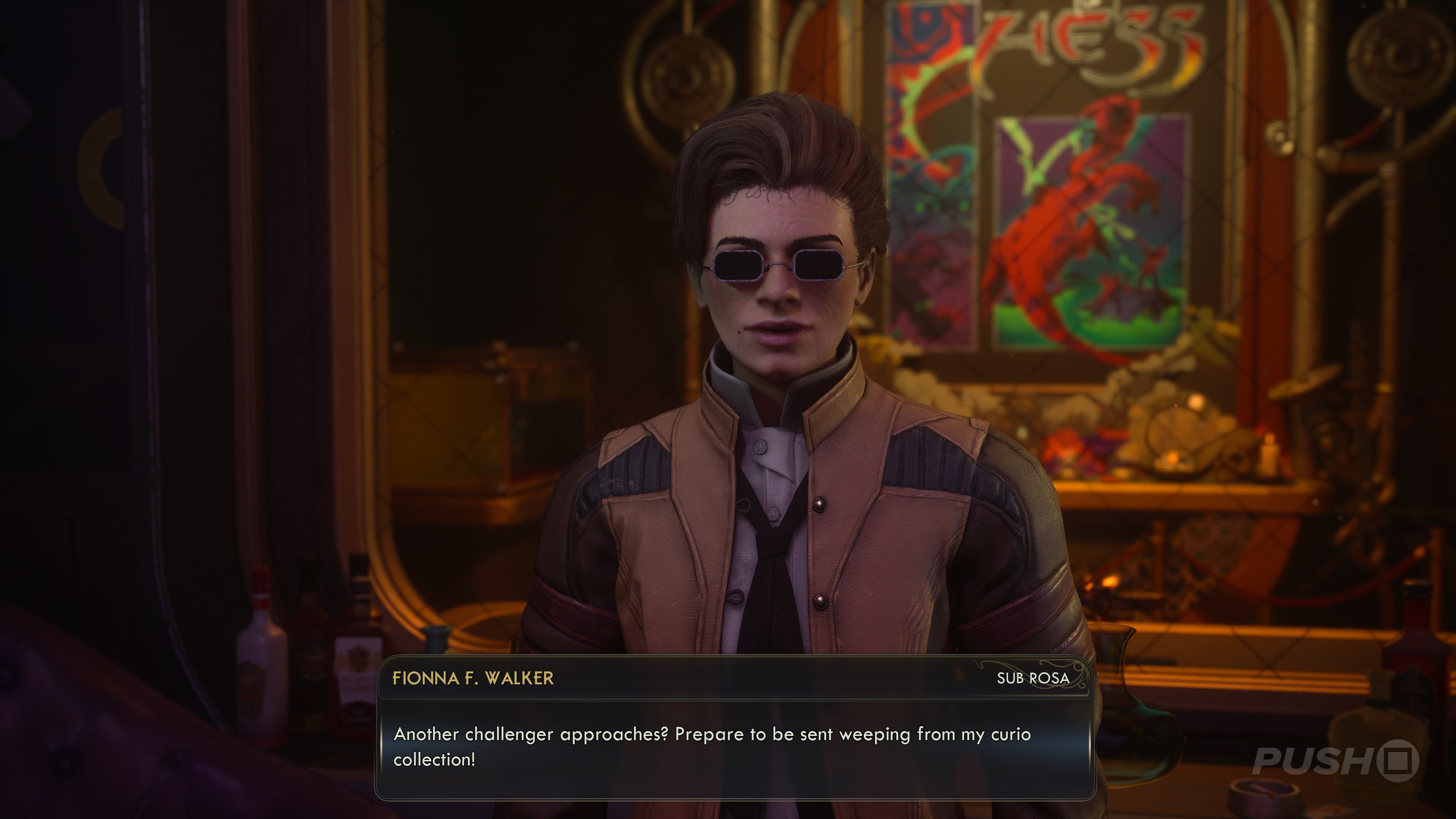
Combat plays a key part in this as well, with the Commander and company having to put down all manner of extraterrestrial beasties as they trek from place to place. And this is another core part of the experience that's much improved, thanks to snappier gunplay and a way more complete melee weapon system.
In particular, firearms have a satisfying kick to them now, and enemies of all shapes and sizes react better to the incoming damage. It's not perfect — there are still times when the action feels a little weightless — but generally speaking, Obsidian's done well to take things up a notch. There are even some cool boss fights to look forward to.
There's a lot of variation in how you're able to approach battles as well. The introduction of 'Gadgets', which are unlocked through certain quests, essentially act as cooldown-based abilities. One slows time, another grants you a damage shield, and there's a nifty device that lets you see foes through walls.
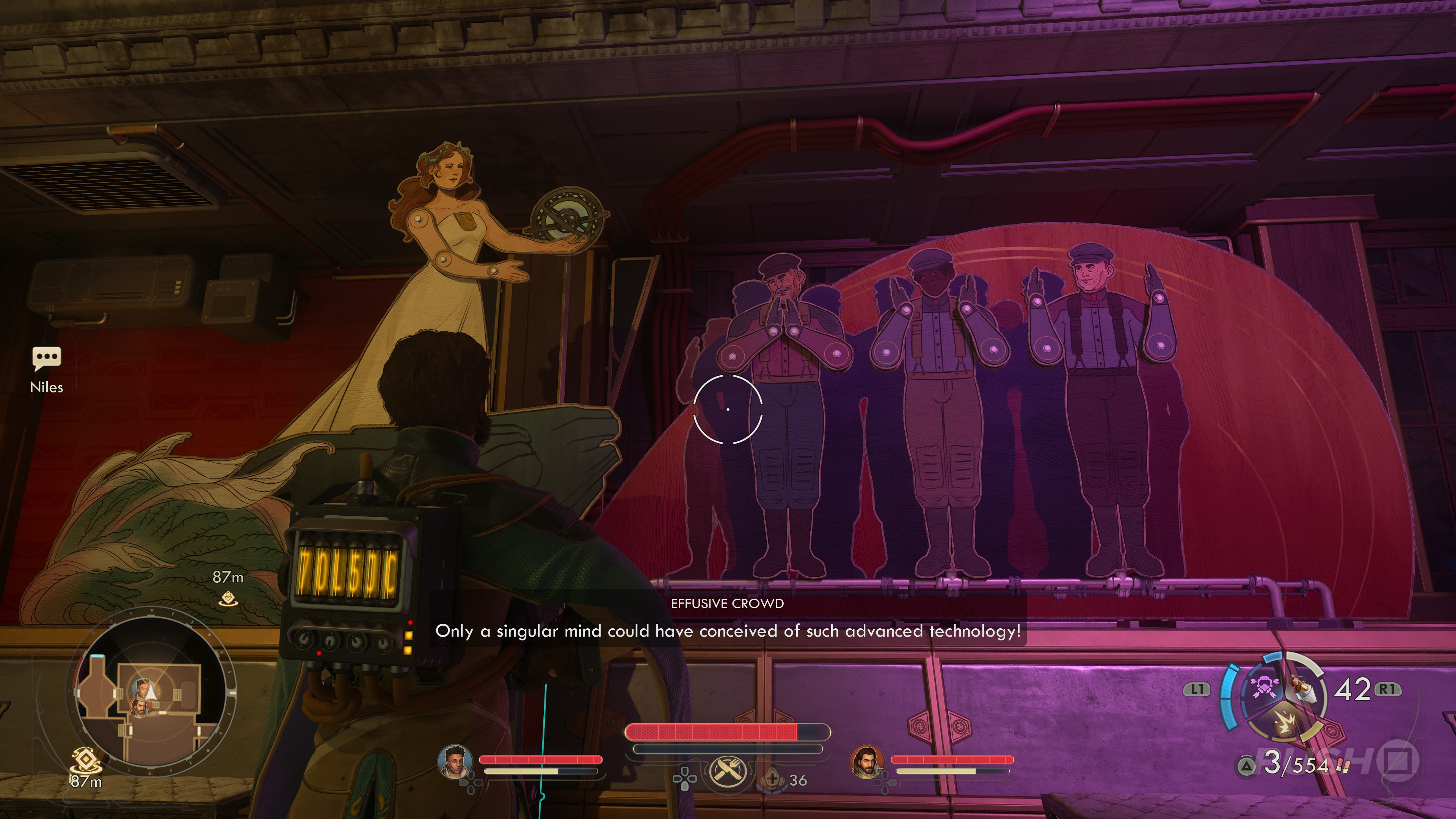
They don't revolutionise the gameplay loop, but the Gadgets lend a touch of personality to The Outer Worlds' brand of action. Couple them with a collection of wacky weapons — like acid-firing shotguns and a roulette-powered war hammer — and it's obvious that the game wants you to have a laugh as you cause wanton destruction.
It's a shame, then, that your allies can still be such an unnecessary burden. As was the case in the first game, party member AI can be braindead, either refusing to enter cover, or consistently performing suicide runs into the heart of enemy territory.
On the normal difficulty, your teammates get knocked out fast if you're not furiously backing them up. The Outer Worlds 2 likes pitting you against waves of opponents — especially during main story scenarios — and it can get to a point where your companions become a liability.
It's not a game-breaking issue because of how competent your Commander is — you can start cobbling together some outrageously effective builds once you're a handful of hours in — but it's absolutely the kind of thing that you'd expect the developer to tweak via post-launch updates.
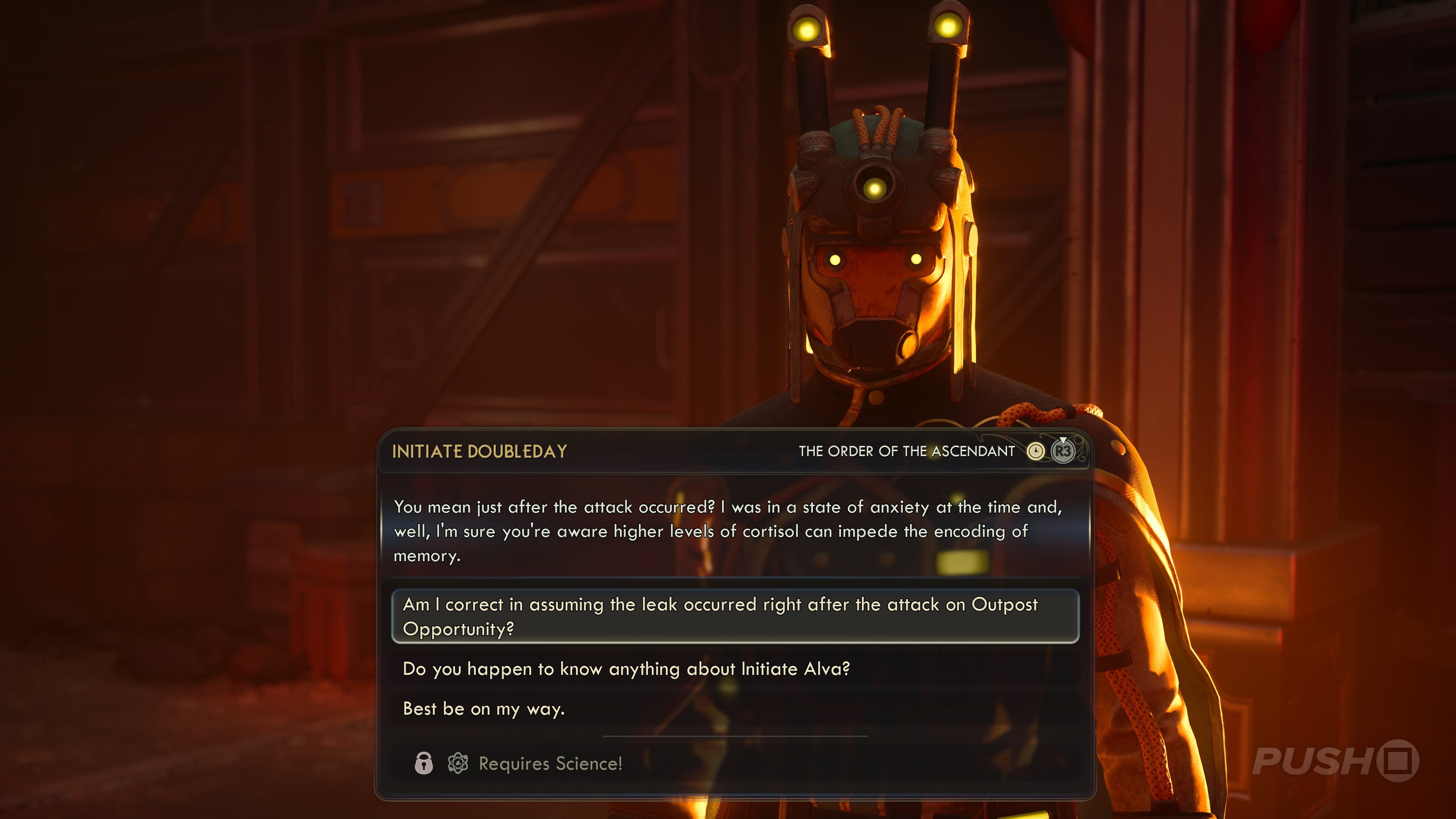
For the most part, The Outer Worlds 2 seems technically solid, but we did stumble upon a number of annoying UI-related bugs, and a couple of quests broke on us, forcing us to load up an older save. Minor problems in the grand scheme of things, but they do add up.
As for graphics, you're looking at your standard Quality or Performance modes on PS5. The former's capped at 30 frames-per-second, which is never ideal in a game with this much combat, but the latter's preferred 60 frames-per-second comes at the expense of reduced environmental detail.
Little things like grass animations are cut back or removed when playing on Performance, and it can be distracting. Pop-in becomes more common as well, and so while it's the better graphical option, it's not exactly ideal.
And speaking of visuals, The Outer Worlds 2 is definitely better looking than the first game, but NPCs still have that clay-like visage, and the facial animations remain fairly basic. There are some brilliant skyboxes to behold here, and each planet's got its own distinctive look, but up close, it's all a bit last-gen.
Conclusion
The Outer Worlds 2 succeeds in being a bigger and better sequel, buoyed by an even greater emphasis on player choice and freedom. Its RPG mechanics are largely fantastic, and there are key improvements to both combat and exploration.
However, despite Obsidian's clever writing, there's an underlying dreariness to the property that it just can't seem to escape. These dull characters and their one-note factions are difficult to truly care for.


Comments 102
If anyone's got any questions about the game or the review, let me know and I'll try to answer them.
I was a big fan of the first game, so I had fairly high hopes for this sequel. And for the most part, I do think it improves on just about everything. If you loved The Outer Worlds, you'll adore this.
But for me, it just never clicks in terms of story or characters. Obsidian's modern games just have this forgettable quality to them and I'm not sure what the answer is.
And for the record, I should point out that I greatly overrated the first game back when I reviewed it in 2019. Again, still a fan, but it's one of those scores I'd take back in a heartbeat!
Thanks for reading.
I had issues with the combat balance in Outer Worlds 1. On normal difficulty I found it too easy but on hard it was too difficult. I also had this issue with Pillars of Eternity - Obsidian need to focus on this area of balancing going forward.
I paid full price for Outer Worlds back in the day. I thought it was mostly undercooked, empty and hastily made.
I would play this as part of a subscription but I am holding off on new games these days.
@OldGamer999 open critic is 79 on 44 reviews.
@ShogunRok thanks for the review is the game ok for the most part on ps5 in performance mode or is there many drops im guessing it will be patched anyway in the future obviously
Even if this game had been a fabled 11/10 game in Phil Spencer’s word, I wouldn’t pick this game up for love nor money. Having 1.3G on a disc is completely unacceptable and is just Microsoft flexing control. I prefer to own my games on Disc and always purchase that way over downloading games. If servers allow for it in years to come, no one that ‘buys’ this game will even be able to download it. The E3 back in the day when Microsoft showed off Xbox One and basically tried to force DRM on everyone was a turning point. But wow, have Microsoft been sneaky in implementing control procedures that are reminiscent to those policy’s. Next they will say that it will be only one download per disc and we will be right back at the beginning of their decision process. That is something that wouldn’t surprise me in the slightest.. Until Microsoft starts to put their games onto disc fully, I won’t buy a single game from their studios moving forward.
Was looking forward to how this would turn out. So all the talk about Obsidian and Fallout New Vegas and they still can't make that one original game that would cement their name in the hall of fame. People should tone down the Bethesda bashings.
@Dan12836666 For the most part it's a solid 60fps in performance mode but there are busy areas where noticeable dips happen — and they'll be worse on the base PS5.
Definitely nothing that'll stop you from playing the game, but performance can be a little bit spotty.
@ShogunRok ok thanks
"So much player choice" is a win in my book.
I'll take the shortcomings!
Reading the review was like this:

I liked the first game but didn't love it and outside a couple of companions, I couldn't really rell you much about it today. Obsidian seem better suited to writing great stories for other people's established worlds, such as Fallout New Vegas or even South Park
From the trailers I've seen and reviews on YouTube the game just looks so bland, don't get me wrong the visuals are definitely better but it's characters, world and setting is just boring. Just give these guys Fall Out Vegas to remake and il gladly buy that.
@Bionic-Spencer same here. I won’t be buying any Microsoft games unless they release them properly on disk.
I suspect, like with the first game, this will be yesterday's news pretty quickly. It'll probably have a nice stint on PS Plus by the second half of next year.
A couple of things I want to say: 7/10 is not a bad score. In fact, it’s good, and even great depending on your view. Secondly, other websites are praising this game—don’t just focus on one outlet. Lastly, and this sounds somewhat contradictory, perhaps we need to stop looking at Obsidian as this RPG juggernaut of a studio. Those are my two cents, or three, technically.
I read through the entire review and guess it would score and 8, @OldGamer999. I based that on all that I read, so I do think 7 is a tad low, as the review read like an 8 out of 10. That said, I am very much looking forward to it...
I have bought the Outer Worlds 2: Premium Edition via Loaded (formerly CDKeys) for the Xbox (because you obviously cannot buy codes for PlayStation games there), and I paid £56 for it. That's a saving of £34 on the PlayStation and Xbox Store price. So if you have a choice of console, and want that version of the game, then you can get it cheaper elsewhere...
@OldGamer999 Hang on, so Sony games have to get a 92+ to be "a hit" in your own words but this can be a 85 and you're chill with it, talk about double standards brother...
Edit: had to look through your comment,s and your exact words are "We are not getting the Sony with 92,94 and 95 scores are we nowadays"
Re-Edit: Finally, stop taking review scores so personally, I disagreed with PS review on SIlent Hill f but still respected their opinion, remember SHf won game of the month so you know...
I should probably start the first game before getting this, eh?
@Oram77 there's always gonna be double standards in video games. Its one of the main working parts of fanboyism. Amongst other things
Was in no rush to buy it with it subsidized elsewhere anyway. Plus the character companions seem like a major downgrade anyway
most places have scored it 80+ so as with alot of push square reviews thier score is lower than average
Despite having this game on gamepass, I won't touch it at all. Writing in the first game sucked so hard it's unbelievable: the whole game is disgustingly lame humour and RICH BAAAD CORPOS BAAAD like it was written by 16 years old. Obsidian that made New Vegas is dead and gone.
There’s only 1.3GB on the ‘physical disc’ version. I’ll pick this up when it’s $1.30 in the bargain bin. Turnabout is fair play.
This game seem like a game made for gamepass.
Playing avowed right now, so this seems to read like a sci-fi skin of that game. I’m enjoying the exploration and combat enough, but the writing/characters/story is just not captivating at all so the rpg decisions/choices don’t really land. Sounds like this has a similar shortcoming, so will probably wait until this is on a deep sale
Edit: and characters with fake Mediterranean accents can get in the bin. Ubi games ruined those for me
A game to wait until it hits plus or essential then.
I think I remember playing a few hours of the first game a few years back but I can't remember lol.
I'll have to play the first game again to see if I'd be interested in the sequel or not.
How does PQ have a review but Pure Xbox don't?
This confirms it that you’re actively trying to bring the metacritic score of Xbox-produced games now Sammy and the crew, according to the pure Xbox regs 😂
@OldGamer999
To be fair, if we’re going purely by games scored 90 or higher on meta. Sony in house studios only had 6 games the whole of last generation, and that includes 3 remasters. Namely:
Sony currently already has 5 90+ games on Metacritic, namely:
And the current generation still has a few years left, with some big Sony AAA games still incoming like Saros, Wolverine, Marvel Tokon and Intergalactic. Not to mentioned titles that havent been announced yet.
This generation might even end up having more 90+ ratings on meta from Sony in house than last gen
@Balaam_ That alone makes it a 6/10
@OldGamer999 I thought we were purely looking at meta scores, didnt know it had all these made up caveats lol
Actually this review made the game more appealing for me.
I've only recently started playing these kinds of games - I 100% Skyrim 1.5 years ago and it was my first one. Then I went straight into Fallout 3 and got 100% in that too. At no point did I care about any of the characters, but I did wish the dialog was a bit more punchy as it was riiiiight on the cusp of it for me. And the combat sucked in all of the games. I also never played with companions so indifferent to their personalities.
So I guess if the combat is great, the exploration is in tighter areas, and the game isn't 200 hours long then it's exactly what I want to play.
That's a good score. I enjoy the outer worlds 1 word up son
@DennisReynolds I think Pure Xbox as a whole has a smaller staff and limited number of reviewers so that may be part of it. That said, it is a big MS release so you’d think this one would have been prioritized.
I'll wait 6 months and pick it up when it's 40% off
@OldGamer999 Is SAROS chopped liver or something?
@OldGamer999 It’s all good hehe. I just wanted to show that, if talking purely 90+ meta scores, that this gen isn't lagging behind last gen as much as people might think. Just thought it was an interesting nuance on your comment of Sony not reaching the same scores as on ps4 thats all.
But i think i’ve derailed this comment section too much already, so lets get back to the Outer Worlds 2
@Fiendish-Beaver yup and actually if one has a decent internet connection and uses the same website:
Rather than paying £59.99 for the juddery PS5 version of Outworlds 2....
Just pay £33 for the PS6 patched version instead, and get to experience that three years early.
How?!?!
One month of Gamepass Ultimate for £12.99
One month of Geforce Now Ultimate for £20
Boom! Play it on an RTX5080 top spec gaming rig worth £2500. If you can finish it in a couple of weeks, you can spend the remaining two weeks playing Avowed.
Almost, @Dogbreath, but only almost! The Premium version comes complete with all the DLC/Expansions. You would need to factor buying the DLC into your equation too... 😉
Guysss, this review is screwing up the game’s MetaScore!!! Xbox tax!!! 😤
I couldn't get into the first game no matter what so this isn't for me
I really enjoyed the first one, so I'll definitely be putting the PS5 version on my Christmas list (along with Metroid Prime 4). Every review seems to indicate it's improved over the first, so sounds like it's just what I'm looking for.
@SeaDaVie Hookshot seems to give all the non-Nintendo codes to PS these days when they only get one code. I feel like Pure Xbox might not be around much longer if an Xbox-published game is only getting a full review on a PlayStation site.
I have the game preloaded on PS5, and I can't wait to play it tomorrow!
An 84 MC is pretty good based on other games in that range.
Also, another 7 from Push Square.. turning into IGN lol.
Ill stay with PowerWash Simulator 2 thanks
@Oram77
I don't think Saros is chopped liver - unless its fried up with onions - you know, something that will really repeat on you...
@Rich33 S tier pun, my friend
Obsidian have sadly lost their magic in recent years, sounds like this just confirms it. They make perfectly fun and perfectly forgettable games these days - but I’ll grab on a deep sale, same as the first one, and enjoy the ride while I’m on it.
My friend and I were discussing Ghost of Tsushima and how it seems a small number of the Bounty targets can be found organically in their "last seen" area without doing all the investigation steps, and how we really liked that.
This prompted a larger discussion about Bethesda, Bioware, Arkane, etc. Those games with that fun level of openness that mostly deliver on giving you a lot of freedom to approach situations. An NPC warns you of someone waiting up ahead, you can use persuade to talk your way out. You can find intel in another room that helps you convince the attacker to back off. Or you just missed that NPC completely and run into the fight organically while exploring and have no way out.
We realized we LOVE games like that. I don't know how else to describe them but they're fun. It sounds like Outer Worlds 2 is in that vein. I'm assuming the first one is as well?
@darylb24 We're all different editorial teams that request review codes separately; there's not just one code for the entire network of sites and only one of us gets it. I can't speak for what happened with Pure Xbox's access, but we source our own independently.
The game runs worst on PS5 pro FYI, and ps5 in general runs worse than the other box.
@ShogunRok
Yeap, that's how I feel about theişr games too.
Before I came in and read the review that headline really makes you think it’s gonna get a 5-6 out of 10.
@Bionic-Spencer I agreed 100%.
I used to be such an Xbox fanboy, until about three years ago. These days, anything Microsoft touches is trash - except Indy.
@Romans12 are you blind???
Every game released this year from Xbox Game Studios is ace.
Pushsquare.com is the only site giving this game just a 7, it got higher scores elsewhere.
I think as soon as sales go higher again, it's over for Playstation gamers getting Xbox games.
Blue boys can be happy for now, that they get to buy current XBox games.
@Hyena_socks Such an obtuse statement. Have your played any of their games recently?
Which was exactly the same problem with the first. I guess they didn't really listen, like they said they did.
@Nintendo4Sonic I don't think I've played a single one of their games this year, nor do I feel like I missed out on something.
@Nintendo4Sonic What on earth are you babbling about?
@Oram77 to be fair. As far as I'm aware this year msft have released
Avowed
South of midnight
Oblivion
Doom
Grounded 2
Gears of war
Keeper (underrated)
Ninja gaiden 4
Outer worlds 2
And the lowest of those is at a 77 on metacritic. With some having worse user reviews of course
Since when is a 7/10 a bad review score? C’mon community. By giving it a 7/10, Robert said it was good, and if anyone knows how to review RPGs across the internet, it’s him. Let’s all remember that not every game needs to be 8/10+ to be worth playing. Based on what I’m seeing, if you’re someone that loved the first one, this will be more of that, but with better writing, according to this review and others. If we reduce ourselves to only play GotY tier titles, get ready for the industry to continue its descent into banality. Play the 7/10s. They’re still worth it.
Having said that, I was hoping to be wrong, but it sounds like my personal biggest issue with the first game persists in the second one, where I do struggle to remember the story (and I completed the first one). The whole first game felt derivative of Fallout as if it was meant to be based on a tale from a fictitious comic book that existed in the Fallout universe or something.
Even so, having played through Starfield, I can’t help but be curious about how this one turned out in the desire to compare them. Alas, with me still having Absolum, Yotei, Pokemon, Silent Hill, and Katamari to play (and Metroid soon enough), this year probably isn’t the year, but maybe if we get a slow patch and a good sale, I’ll be in.
@Kierant202 That had nothing to do with what I meant, but thank you for listing games for...... reasons?
I really loved the first game but for the life of me I can't remember anyrhing about it. I'll definitely play this when the price comes down.
@Nintendo4Sonic lol, there is no reason to buy an Xbox. Pc game pass is half the price and you get all the new releases. When is the last time a Microsoft studio had a game of the year winner? Or nominee? It just so happens their studios have games ready the past two years. There will be a dry spell coming shortly.
@Kierant202 also, ninja gaiden 4 is not a Microsoft studios game. It's Team Ninja and Platinum games.
@mvhess they did publish it. And I don't think the reduction of ninja gaiden makes that list any less relevant. Msft may be a ***** company but it's just a waste to deny any games by their dev teams because of that. They were a ***** company for a long time. Long before they started making games and all they way through their best days.
And it's not like Sony or Nintendo are super nice guy consumer first companies. It's all just stupid internet posturing on social media sites and will never be anything more than that
Fair warning for anyone thinking of picking this up - I haven't watched the video as I'm not that interested in the game by DF's review headline is that the PS5 versions need work.
Another example of why Xbox isn't genuine about being properly multiplatform, despite what they say.
Got the platinum on the first game. Forgot everything about it afterwards. So I will not play the second.
At first I thought hmm, but the more i read the more i went I get what you mean. I am impressed by this game but for 'what the studio wanted to do' not because it's actually pushing further of it's potential as the devs won't do that. No choice based RPGs with 'consequences' as they really don't at all and are still limited by the devs fixed approach making them underwhelming if you think too far because they would have to account for more and they won't.
Also the factions having like few quests is pointless, I get it's not a Middle Earth Nemesis system or others type game, but why even join a faction if they are used so little. The 'most players play the story and everyone needs to have a perfect experience' is why I find modern games boring. I enjoyed Infamous Second Son side quests and knew the story was the main experience/for casuals. I assume many open worlds vary in their target audience content/execution for sure.
They want a movie/book like story, the player wants a world to do anything in. Oh that doesn't match up. See the problem.
I mean in Mass Effect, Fallout 3/New Vegas, Dragon Age, sure but to me they seem limited still. I mean if in Mass Effect Shepard said nah I'm not bothering, you would have more game overs, but devs don't want to do that.
It's why Nier Automata the many endings were funny but made sense.
Visual Novels you get bad end choices.
But choice based RPGs refuse to do this. They are too strict in their 'follow the story but say something aggressive and lose some people along the way' but it's still so stuck on 'the story must happen'.
So you aren't really doing what you want at all. Just being good/bad or more so nice or aggressive and that's it. So why bother. XD
So they can be too hand holding beacuse you wouldn't be playing what the devs have sculpted. Which makes the games feel limited.
Sure many games have limits we don't even everything to be realistic or accounted for (I hate realism so to me I'd rather more fictional elements, the problem is we have to ground things for 99% of the gaming audience casuals or hardcore so we can't have that can we, sigh).
Sure us gamers are used to limitations but sometimes they do ruin games then feel like a fair thing to do. Especially for games like this with such scale that the limits keep hitting themselves in the face.
At least if your seeking more then the story and side missions or the limited scale of the game.
I mean there is a reason why even mic choices in say Binary Domain are limited. You could say anything but the game is meant to work with what is programmed.
If dialogue choices were as flexible as objects you pick up with and fight with in Dead Rising it would be amazing, but it's not.
My guess is like many devs, they offer evil options but really don't care far enough with them.
Part 2:
Even Infamous Second Son I was like oh set points for good/evil choices, oh if I am bad enough my good powers are limited in the skill tree. It felt stupid. You either go full good/full evil, are forced on a story or side quests as things to do in the game and what's the point. No 90% good powers and 10% bad powers and the ways to fill up good/bad again were so minimal it made story progression pointless if you wanted to flip choices.
Even Infamous 1 had action based ones in the intro (not played enough of the first game yet) and I was wowed by this. It just defaults to the other but it was interesting even if scripted it felt like it wasn't.
Games don't really do that or want to go further. They just have limits and we have to accept them. But sometimes those become annoying or the scale is too unappealing for the scripted nature they are providing.
The choices to me are as deep as they should be and what the studio has wanted to do for years, but the problem isn't so much the dystopia and the humour (sure it's the core so they aren't going to change it that much) but it's the extent at which they push things is still too limited or too restrictive so the impact I agree is still too limited.
I mean if you wanted to go to a different planet and ditch everyone or your duties, you can't. You have to follow the story/what the game offers.
Do RPG things, do XP grinding, get party members, do story quests, do errands, annoy NPCs, do side quests. There is so little to do really. The games are obvious of their limitations/scale and become boring if you don't follow what the game wants you to do because there is nothing else to do.
At least the GTA NPCs react and say different lines of dialogue, or I get why people can just bother NPCs, escape the police and more. Most games are so 'good guy' tame and 'we made a story play it please' and I'm like nah.
It's why to me in open worlds I find them boring as the back drop to just generic action adventure/RPG stuff is just so boring.
It's why I seek out the tower defence over outposts approach of Sunset Overdrive, the fair side quests in Infamous Second Son, the combat/flight path side missions in Gravity Rush or Sunset Overdrive.
Not errands I find boring to do in every other open world.
Part 3:
It's why even if linear games are scripted even more I find what they are wanting to showcase to be way more interesting, they push whatever movesets or abilities or items to their limit they can come up with, it's even more theme park like but it's less 'we have a world but it's so theme park limited you just have to do these things as there is nothing else to do' and I'm like oh so that's boring.
But in a linear game, I want to see what ideas they have and how far they stretch them.
Choices are so particular but only do so much. They don't lean into things a lot.
This I think is why choice based RPGs really limit themselves too much. A TV show may lean into it hard, but a game has always had this limitation and it's what I want any of these devs to do, but they don't. The choices come off as 'this is a conversation' but the impact is very much 'you can say good/bad things but we don't want to stray too far from the core story we built' so really it all means nothing because the scale is too large and they refuse to act on it.
Making these games just so pathetic because they keep curbing the limitations too far and the games scale is always limited because they don't want to go further as it's too much work. Then why bother?
The number one priority in RPGs, for me, is the writing (really in any game that tries to make the story a significant part of the game). Sounds like I will enjoy this game as much as the first one, which was not that much. Wait for steep sale for me.
I just watch the DF review of this game it seems like Microsoft like making their games run way worst on PS5 & PS5 PRO🤔
@ShogunRok Heads up, missing an n in the last paragraph: "there's a underlying dreariness..." Also, just so you know, I caught this over on the review roundup on Pure Xbox, meaning it's also missing there.
Sounds a little uneven, like the first game, but I'm okay with that. Hope I get a chance to play it someday.
@Nintendo4Sonic like what?
@tselliot you mean Doom The Dark Ages, Tony Hawks 3+4, Ninja Gaiden 4, Outer Worlds 2 or Keeper are nothing?
@mvhess that's just crap you're talking.
@cburg apologies, that was an unfair statement (therapy day, so a bit grumpier than usual).
I’d be very happy to be wrong, the most recent game of theirs I’ve played was the first Outer Worlds.
Was Avowed, grounded or Pentiment any closer in terms of character, personality and emotion to their earlier output like Fallout: NV, NWN2 or KOTOR2?
The year 2026 AD is almost around the corner and the fanbloid reviewers still unironically think that "dull characters" or "boring story" are of any informative value for a reader. What metric units is this dullness being measured in against other works in the genre, may I (rhetorically) ask?
@Dan12836666 So wait for it to go down in price is the way to go a broken game can just as well be bought at a cheaper price and fixed.
Tldr: Sale it is!
Redaction:
Will never buy it for the disc holds a download cue.
@nhSnork valid question, of course, but every single review is tainted by the reviewers own tastes. CrimesNewRoman has a well crafted video on reviews. Top lad as well!
@SuntannedDuck2 My problem with the choices in Infamous that its always good or bad even when you do something that is not really Evil it counts as evil and one choice you totally not agree with locks you our if the best powers .
@ButterySmooth30FPS to be fair VCG gave it a 6 because they didnt like the game publisher and spent half the review moaning about Microsoft the company not the game it self
@Balaam_ you would hate playing pc games
looking forward to getting this, MrMattyPlays and Jake @gameranx reviews very helpful
@Dogbreath
That's pretty cool - for 20 dollars a month you can stream from a High-End PC?
Why are people always talking about buying their own if it is that easy?
@EfYI well I think the obvious one is that it's not a PC replacement. Not all games are on GFN and your can't tinker and mod games as much, although there are mod support in a number of games now.
You also can't use it for word processing etc or Web browsing. It's more a mega console.
Typically one would say buy a mini PC for £400 which does all your office tasks, photo editing and light video editing work.
Then pay £200 a year for Geforce Now that gives you £2500 RTX5080 gaming rig performance and free upgrades for life.
Essentially GF Now is far cheaper than the delta between an entry level laptop and an absolute monster PC.
The issue is still that some games are missing. E.g. Want to check out Outer Worlds 1? Alas it ain't on it. Neither are Rockstar and a lot of WB games.
Will GTA 6 be on it? Who knows.
For a console gamer though it's handy to get a cheap key and a month sub when the console version is awful. GFN is not quite "your only game system" just yet unfortunately.
@darylb24
This is the truth. They'll be folded up into this site quite soon. The humiliation of the most bullish fan boys of Exbox will soon be complete.
They funny thing is that PS players only really took notice of M$ when they tried to swallow up ABK, and most of the criticism was legitimate worry that it was a terrible decision (not terrible if you wanted M$ to only be a publisher/software company).
I imagine the thousands of accounts and online personas have been or are being canned as they move on to other online communities.It is like Age of Empires 2 where the 'wololo-priest' quickly makes team green blue or red.
Then there's all the game 'journalists' and influencers that has to pivot or lose their jobs.
This is... of course.. unless Xbox gamers proudly and loyally swallow up the price rises and chip in where they owe M$. They had been bankrolling this entire generation for a very large part of their player base.
@Dogbreath
Thanks! I think you raise some good points. The only disadvantage is that you don't own hard- and software. We might look into a world where your technological devices retain their value making your investments more like actual assets.
I know what you mean by a mini-PC. I see them on sale now a days. You don't need much more and the last PC I bought were a very cheap but great laptop for my wife. It is hardly stronger than those new minis.
At the end of the day, I am too lazy to look into GeForce as a real option. The meagre selections of streamable titles on PS Premium will have to be enough to satiate my streaming needs. But still a great tip people might want to look into. Have a great weekend!
"In one ear, Outer the other" - that really sums up my feeling of the first game tbh, but I still had fun and actually finished it which says a lot these days. A little burned out on Borderlands 4 so this could be a good palatte cleanser
@Nintendo4Sonic good for them. They bought up a ton of legacy studios and they released games this year. Not one of them is a game that's going to remembered as truly great. I have no idea what you are even on about. They own half the industry at this point so of course they're going to put out multiple 77 metacritic games a year. They have no system sellers or they would've sold systems. And yeah, get a gaming pc before shelling out a thousand plus dollars for the next Microsoft branded box they release and call it an Xbox. Sony and Nintendo maybe can release 2 first party games a year just because they don't have 50 studios. Meanwhile the actual Xbox franchises not named Forza are dying. Gotta buy up existing IPs to be successful. And not just existing ones but the biggest ones. I just hope my beloved Doublefine isn't the next studio to get canned.
@EfYI Sounds like they made the sequel to be SSDD. All that "we listened" turned out to be malarkey. Probably way to Western influenced.
@Flaming_Kaiser I agree, they can play it too safe and it makes the choices feel worthless.
I get why the teams do it but it makes that feel more like advertising a feature then offering a purpose to it, even beside the strict nature of such stories too because you can't always make someone leave (in a party based game at least and it depends on the game). For no soft locking/game over sure but even still.
Or the extent at which something is 'evil' wow they yelled at them or mocked them. It can be funny but yeah it doesn't go very far.
Also it's always weird to me how in GTA you can because they just allow the police/army or NPCs to just respond but you can interact with many things, while in other games devs are like 'oh we can't do that we have to be very safe and good guys or we don't want the news going after us and our reputations' or something. Or they don't care to program/write dialogue/voice act or offer such interactions.
They don't have to account for everything but some players are going to. It's why the little things can make a game more compelling or memorable.
From heat/flags moving, tvs showing footage (fake or tracking the player) or crowds in a racing game, to other details in many other games (forgetting which right now).
Or they just don't think negative enough ideas for the games so won't do it and It's like why? It's a video game. I mean for Infamous a lot of superhero or random ideas could easily be thought up during the course of it's run.
Why have an evil path, why have aggressive dialogue/acting portrayals? It's just weird. They don't really do anything with them. A lot to expand on sure but even still.
It's too much about good/bad points or dialogue and doesn't amount to much.
An anti-hero sure they can write one but those games (as far as I know) don't really go for evil as much or if they do it's not like a choice based game, it's clear what their anti-hero/villainous motives are.
But a villain based games maybe they do, as often as we get villain based games.
But yeah Infamous those choices to be evil were a cool idea just not the best executed I guess.
I only beat the 2 PS4 ones though I own the PS3 entries (not Festival of Blood though) I just haven't progressed much in them yet so I don't know how well they offer evil choices.
Outerworld 2: great rpg fundamentals, forgettable story. 7/10
Ghost of Yotei: great but interative fundamentals, far more bloat/repetitive exploration incentives, forgettable story. 9/10
🤣
@SuntannedDuck2 The problem with Infamous the latest ones especially you feel like there is no grey zone. Its good or bad and even worse it locks you our of moves if you choose the better option. It makes that you dont really have a choice of what you want to do your put on tracks.
@Flaming_Kaiser Agreed. I was sad that if you mess up NPCs or something you take so long to get back to that level of good/bad, it's so dumb. Oh I happened to be bad a few times to see what the game can do, here is an entire level or less you need to regain because we want to punish you? What kind of garbage excuse is that and the auto saving I think as well.
It's strictly good and strictly bad and regaining it is a pain because the good points or bad points increase rate is so slow. It's so badly offered. Or the amount they take away or what skills you lose access to. It's so dumb.
They have changed with with Tsushima/Yotei and some of it makes sense and I went why not just commands (fair stances rather then too much focus, type commands, or is 'automated NPCs that aren't very good as doing what you want them to do so why would we give players subtle control over them', maybe even offer a better bonding system or other factors, versus what they offered, the way of modern gaming these days I guess, I don't know, skill trees being the excuse of everything doesn't give me much interest in them at all it's why I hate them so much is why they get used not smartly get used) for the wolf not useless skill tree pushing but whatever, that's just me. Then again Outer Worlds and Bethesda titles do follow old skills direction of RPGs so they differ of course in what they are used for.
Back on topic: I would have wanted a mix of oh good/bad powers but no it's restrictive.
Even then it's so point based and not like 'Mass Effect or Infamous 1' with the 'act on this in time' kind of approach which wasn't much but felt it had more purpose to it then a points system and being heavily restrictive or pointless and ruining your story progression to bounce back. That's not appealing to the player it's just punishing them and making them want to give up a grind of points.
At least the missions in Sunset Overdrive/Infamous PS4 era was fun, or else I would have given up. Beat both PS4 era Infamous games but still.
It's too much 'we only scripted so much' or we have to be scripted to fit in with Sony or other devs expectations these days and I'm like well that's just silly. It's why I find some scripted things just a joke rather then balancing. It's why I don't like certain modern game design is the scripting ruins it rather then being fair balance of scripting to balance things.
It's why I can compare GT7 or FM6 to PGR2 or other racing games of how they do progression in their games, I think the former are terrible and the latter did it fair for it's restrictive progression, but then PGR3 had to be 'so open ended' for a certain audience as 'all modes' were, not just 1 mode that suited the strictness more so that was also on the devs going too far with it but I didn't mind as it was still flexible enough with it's strictness to not bother me or the core was better too.
Compared to say other action adventure games with fair motivation in the game to play it or fair strictness I'm ok with varies, while others I'm not.
But in a way that's punishing they ended up with which is annoying rather then a good excuse for balancing they could claim it as.
And good and bad isnt always black and white just like real life.
Show Comments
Leave A Comment
Hold on there, you need to login to post a comment...