
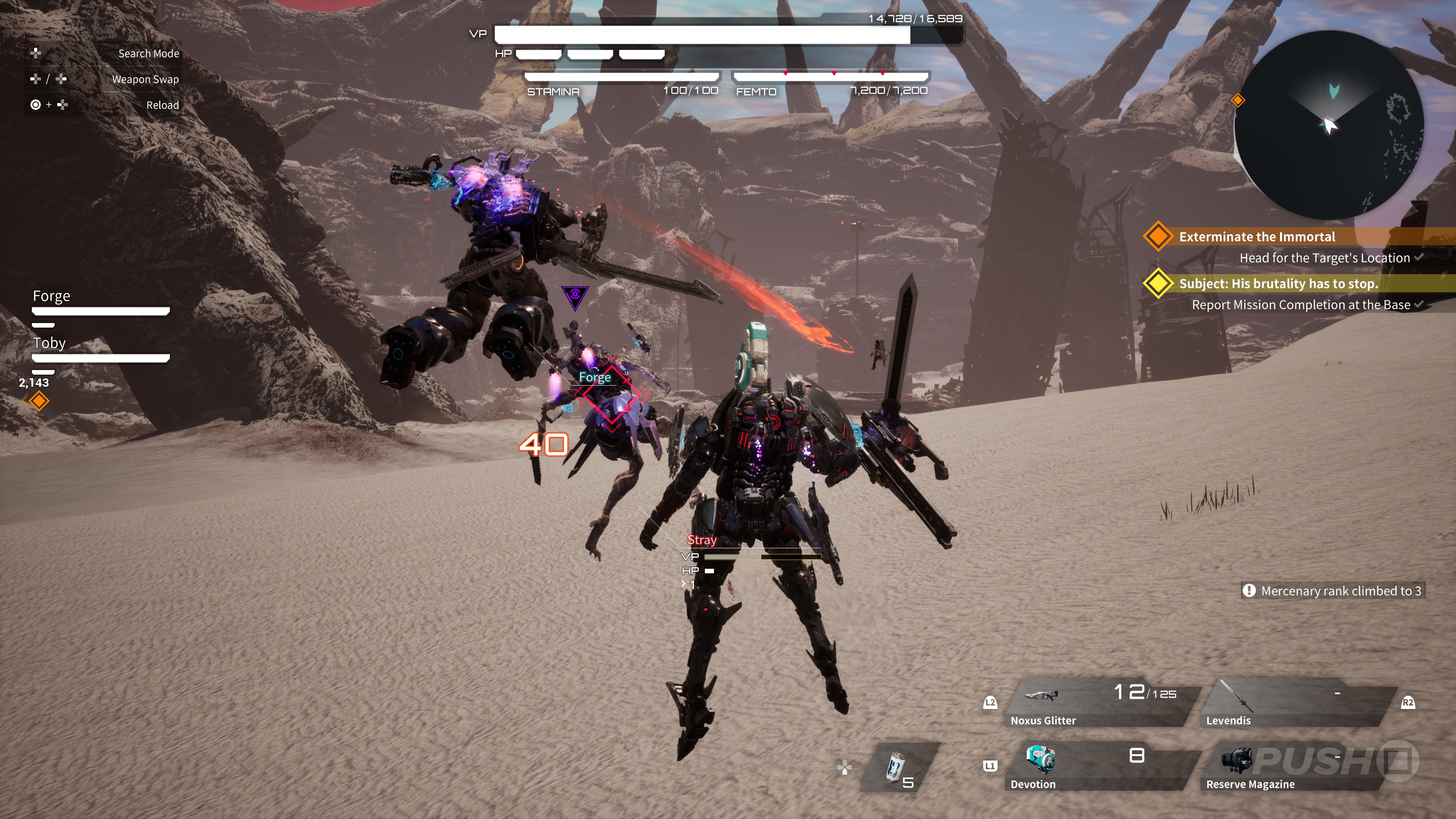
Daemon X Machina: Titanic Scion makes a rough first impression. After creating your custom protagonist, you're thrust straight into a chaotic action sequence with next to no explanation of controls or mechanics.
You haplessly slash and blast your way through a series of samey sci-fi corridors as characters waffle over comms, and the whole thing's just an overwhelming mess. The barrage of janky cutscenes that follow certainly don't help, either.
But then the actual game begins and you gradually start to realise what this sequel to 2019's (Switch console exclusive) Daemon X Machina really is: a mission-based, open world grind-a-thon with an especially wonky story tying it all together.
We use the word 'wonky' because the plot really does lurch from one sci-fi trope to another. It's not a bad narrative — there are some fairly interesting concepts and almost post-apocalyptic themes to chew on — but between shoddy cinematics and a cast of underdeveloped characters, it's hard to get truly invested.
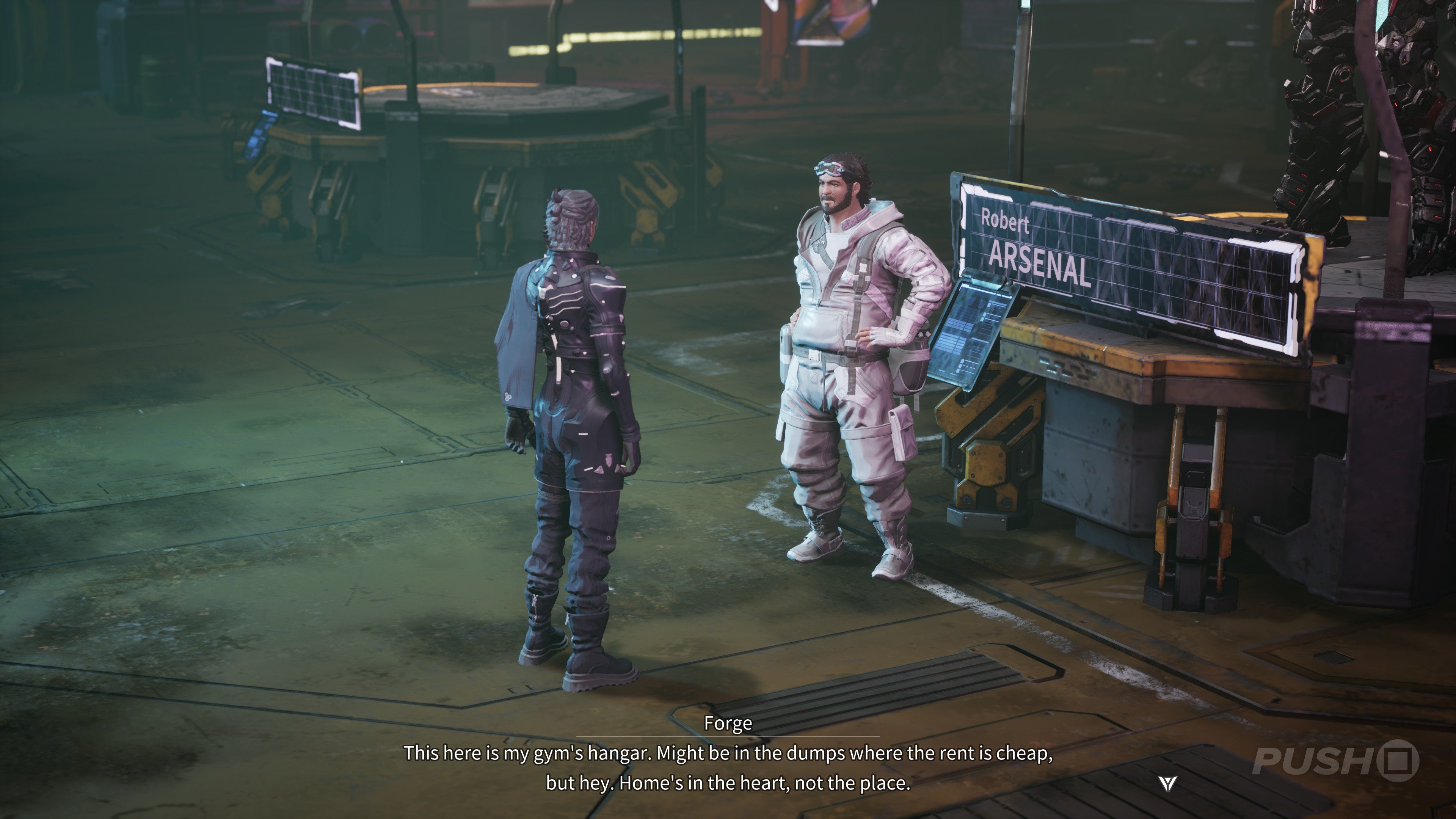
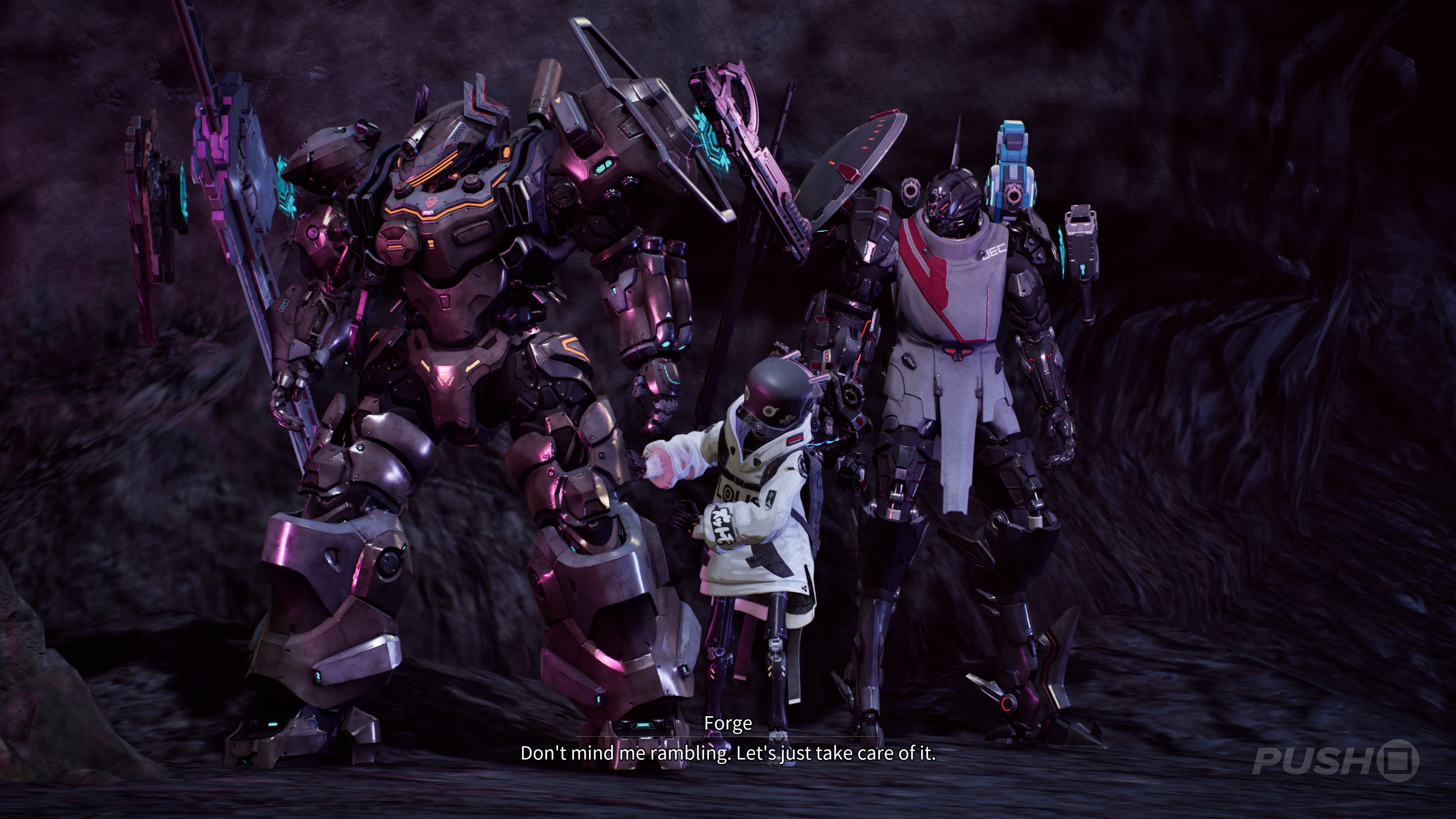
Upon fleeing from a research facility up in space, your character — an experienced mech suit pilot — crash lands on a rusty old planet where they befriend a ragtag group of opportunists. The goal is to get back to that orbital colony, but you'll have to acquire some serious firepower in order to stand up to the planet's tyrannical overlords.
And so begins an endless checklist of objectives that'll have you scouring mostly barren environments for resources and better parts for your mech. At its core, Titanic Scion is basically a loot-based RPG, in which you're making constant adjustments to your Arsenal — a fully customisable, Iron Man-esque mech suit.
The sheer amount of ways that you can rework your Arsenal is impressive. There are hundreds of different parts to discover, all with their own stats and passive perks; body parts determine things like protective armour values and movement speed, while weapons define your style of play — and you can have four equipped at any one time.
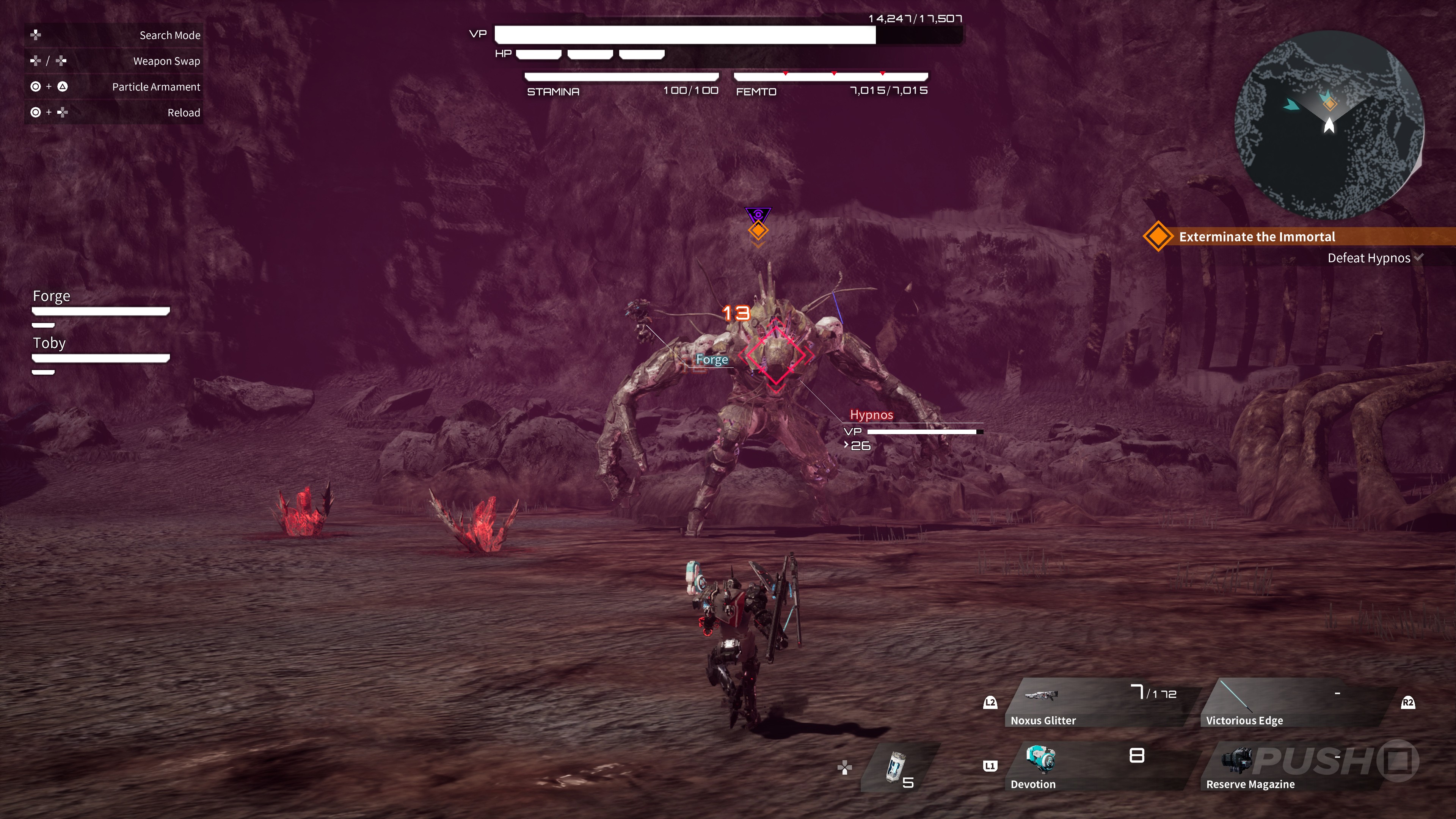
It's the kind of game where experimentation is key, and you probably won't settle on a favourite approach until you've sunk hours upon hours into the release.
Having said that, the non-stop loot drops do bog the experience down in time. When you have eventually settled on a specific style of play, or something close to it, the act of sorting through all of your loot just to find minimal stat boosts becomes a chore.
What's more, selling or scrapping your unwanted parts is a bit of a nightmare thanks to chunky menus and convoluted sorting systems.
Outside of these dreaded menus, however, Titanic Scion is a surprisingly freeform experience. As alluded, the open world locales encourage exploration — but unless you're just passing through as part of a quest, there's not much to see off the beaten path.
It helps that your Arsenal is capable of flight, bringing some welcome verticality to the formula, but the overall problem with trekking out into the wilderness is that sections of the map just feel lifelessly vast, to the point where you're traversing a whole lot of nothing for the sake of a single treasure chest or enemy that's defeated in the space of several seconds.
Speaking of battle, combat in Titanic Scion is a pretty straightforward affair, combining simple melee combos, basic gunplay, and timed dodges. In fact, it's so basic that the early hours can struggle to hold your attention; it's not until you start unlocking more advanced weaponry and abilities that fights really start to take shape.
In particular, the boss fights are, more often than not, fantastic fun. The game's snappy targeting and movement controls lend themselves especially well to one-on-one duels with other Arsenals, leading to some intense, Armored Core-like bouts.
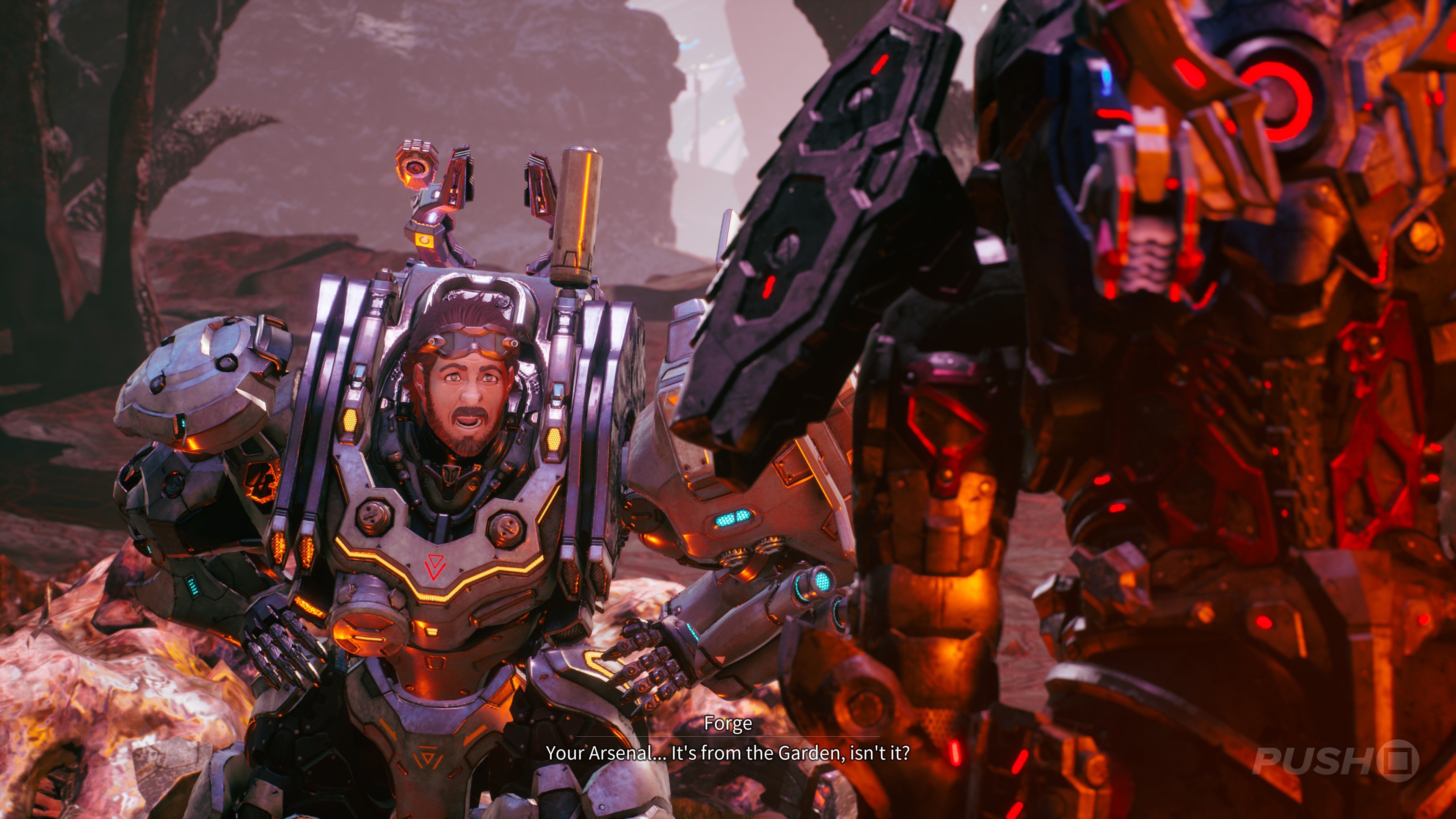
And again, because there are so many ways to alter your Arsenal's build, it feels like there's a sort of hidden depth to combat. There's no question that more hardcore players will relish the opportunity to tinker with different weapon combinations, uncovering attack patterns that maximise damage or keep opponents completely locked down.
But ultimately, this is where Titanic Scion struggles. In order to reach its more interesting innards, you need to spend a good chunk of the game fiddling around with annoying little aspects of its design, like repetitive mission structures, a never-ending supply of largely pointless loot, and environments that are too barren to be considered engaging.
Conclusion
When the central gameplay loop of Daemon X Machina: Titanic Scion starts to click, this is an action RPG with serious potential. But all too often, the joys of customising your mech and the thrills of hectic battles are held back by tedious design.
With its barren open world structure and constantly expanding progression systems, it feels like Titanic Scion stretches itself too thin — but if you can stomach the missteps, there is a deeply addictive quality at the game's core.


Comments 15
I was sorta interested in this one, but I have to admit: In a crowded month of releases, this one doesn't even scrape the surface with the middle of the road reviews.
Mad, I’ve seen a load of 9s and 10s for this one on PC and Switch… the PlayStation-tax be real! 🥸
@graymamba I mean, not really lol. Even Nintendolife gave it a 6, it looks like it's barely averaging at a 70 on metacritic. I actually haven't seen a single 9 let alone 10/10 score
I picked the first one up for £2 on steam. I'll have a go with that one first.
NGL this sounds exactly like the kind of game I'd get into lol. I'm someone who cares very, very little about stories in my games and in general expect them all to universally suck, so I tune them out regardless. Gamers losing their minds over their precious stories is getting out of hand. If you want a great story, read the work of a real author.
Not trying to troll or anything, it's just interesting to me that the game world has decided that programmers should have the writing chops of someone with an MFA in creative writing all of a sudden. Writing good stories is very, very hard. I can only imagine doing that AND wrapping a video game around it and dealing with all the egos that go along with development/production.
How interesting can you make "outer space mech game" anyway? I think most mech gamers are here to geek out with mechs. Space stuff happens. End.
I have not heard about this game. This screams €40.
"Graphically ugly"
Is it that ugly? From the trailer it looks fine but the artstyle looks nice especially the mecha design looks badass.
But eh, i'm probably gonna skip this one...
When it comes to this it's like I always enjoy mechs but the PS5 already has far better mech games and I already got most of them.
@Flaming_Kaiser Yeah I'd say this game is a total "maybe consider when it's very well discounted" sort of situation. Especially considering how they're trying to charge $100 for the game with all the DLC, there is just no way this game is worth anywhere near that much.
I didn't read the whole review, but the negatives reminded me of the amazing time I spent with Trails of Cold Steel so I'll probably give this a go 👍🏻
I really liked the demo so I think I'll buy this. A bit surprised that got a 6/10 like Lost Soul Aside, when imo this game is better and cheaper too.
@Dorkthrone You can hire a writer. If you like immersion and exploring new worlds, good writing is critical. Mass Effect, Dragon Age Origins, New Vegas etc would be nowhere near as big if they didn’t have great lore and immersive writing. It doesn’t have to be the best thing ever for it to work, so when it’s clearly positive for it to be decent, it’s disappointing for people like me to see it’s not. You don’t care, good for you, more games out there you’ll enjoy.
Played the demo on both Switch and PS5. The Switch version is, imo, unplayable due to its low framerate and overall jank. But I had a lot of fun with the PS5 (Pro) version. I definitely agree with Robert’s critique of the empty world and super-lame story/characters (blech…), but I think if you love mech combat and customization, there’s lot to like here. It’s a game where you can just turn your brain off and have fun with the mech power-fantasy. I will certainly pick it up down the road on a sale.
Played the demo. But after a promising opening, it quickly turn into the same boring open-world fluff as usual. The world is so damn boring. I prefer the first game.
@JayJ If the game is this middle of the road indeed this dont overprice it i totally agree on that
Show Comments
Leave A Comment
Hold on there, you need to login to post a comment...