
Giant Squid is one of the best developers in the biz when it comes to crafting beautifully breezy indie adventures. Sword of the Sea, its latest outing, will never escape the obvious Journey comparisons, but it still stands tall as the team's most refined game to date.
Without wanting to strip the title of its elegance, Sword of the Sea is basically what you'd get if you mashed Journey and ABZU together, and seasoned them with The Pathless. It's a delicate mix of meditative exploration and slick platforming, backed by simple but evocative storytelling.
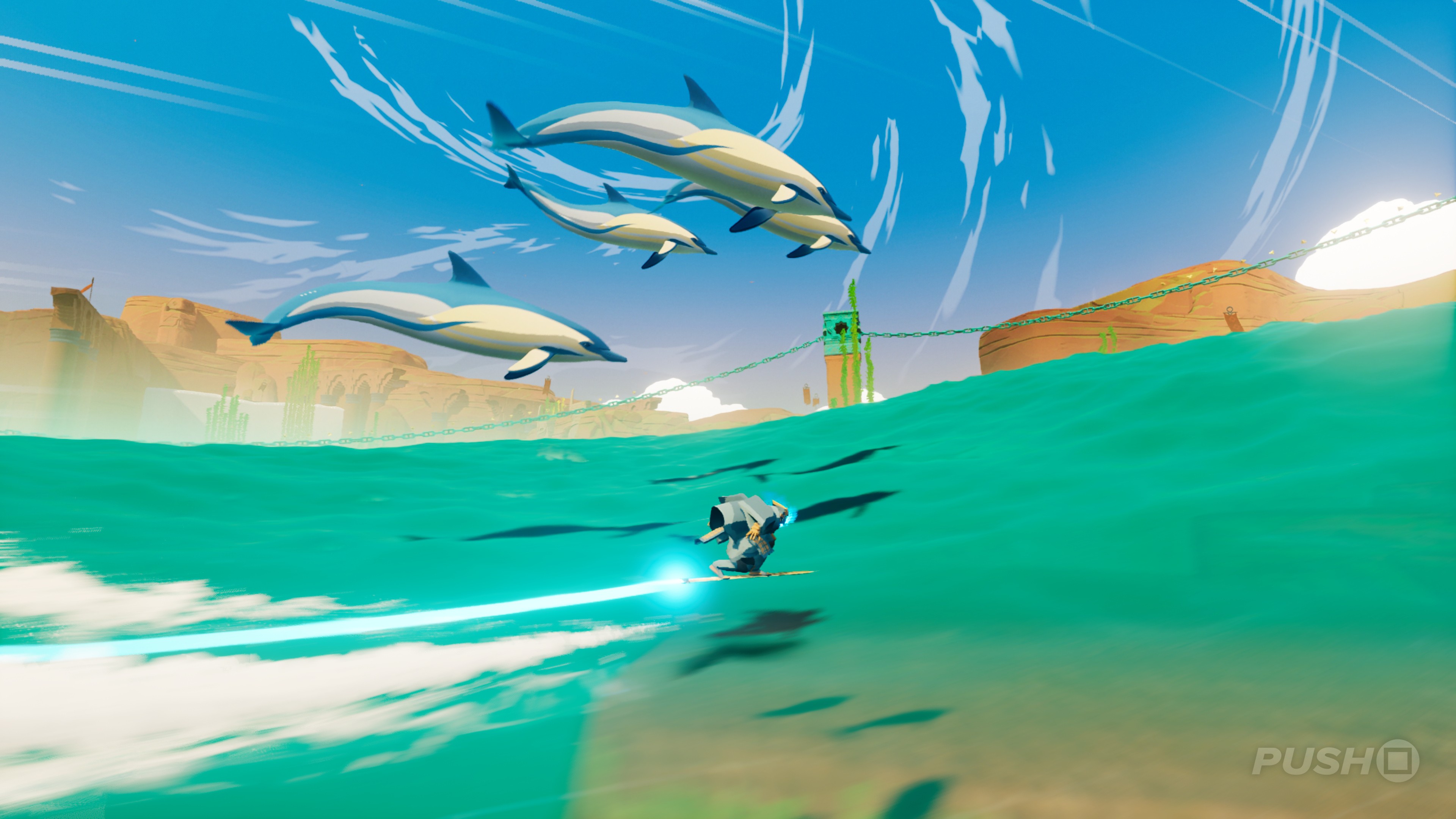
In a lot of ways, it feels like a true spiritual successor to both Journey and ABZU, and so if you're familiar with either, you'll already know exactly what you're getting into here.
Sitting at around 3 hours in length — almost certainly less on repeat playthroughs — Sword of the Sea provides a fulfilling trip across the desert sands and abandoned cities of a lost civilisation.
It all begins with the awakening of your voiceless character, who's capable of riding a large sword as though it's a surfboard. Gloriously smooth controls make traversal a delight, especially when you're zipping through the game's larger, more open environments.
Actually, Sword of the Sea is a surprisingly speedy experience, and as such, it requires a bit more finesse than something like Journey. As you progress, the platforming challenges get a little trickier, and you'll need to start thinking about hitting top speeds before taking on certain jumps.
That's not to say this is a difficult game — the only penalty for falling into an abyss is a brief reset back to solid ground — but it is more involved than its spiritual predecessors. The same is true of the puzzles, which, while simplistic in design, do make you consider your surroundings.
Our point here is that Sword of the Sea is more of a game than Journey or ABZU are — and this is further evidenced by the fact that you can rack up points atop your surfsword by pulling off tricks and flicks midair. Learning and mastering these techniques is entirely optional, but again, there's a certain degree of gameplay depth on offer.
Does that detract from the overall experience, though? Journey is such a masterpiece because it's so streamlined as a slice of interactive media; it doesn't get hung up on elements that would be considered 'traditional' game design, like scores or collectible currencies — or even text.
Sword of the Sea dabbles in all of these things, and we think, at least to some extent, that they cheapen the title's meditative tone. Don't get us wrong, so much of the game is masterfully pieced together — but it's a point that's worth pondering.
For instance, gathering that collectible currency we just mentioned, or stopping to read lore-related messages attached to obelisks, often disrupts the flow of each locale, pushing you to backtrack for the sake of unlocking new aerial tricks. There's no doubt that Sword of the Sea is at its best when you're just gliding between environments and soaking up the vibes with zero distractions.
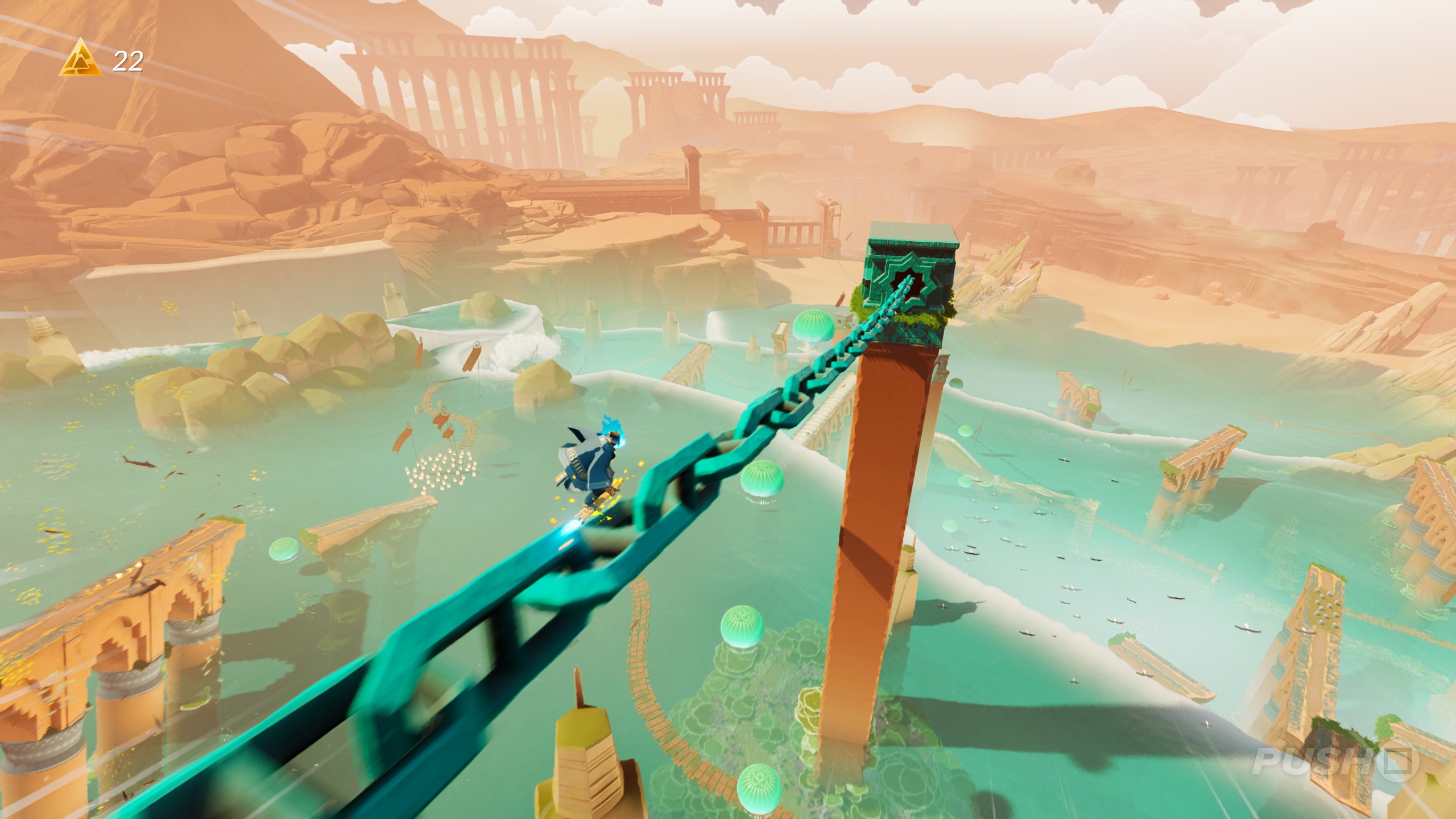
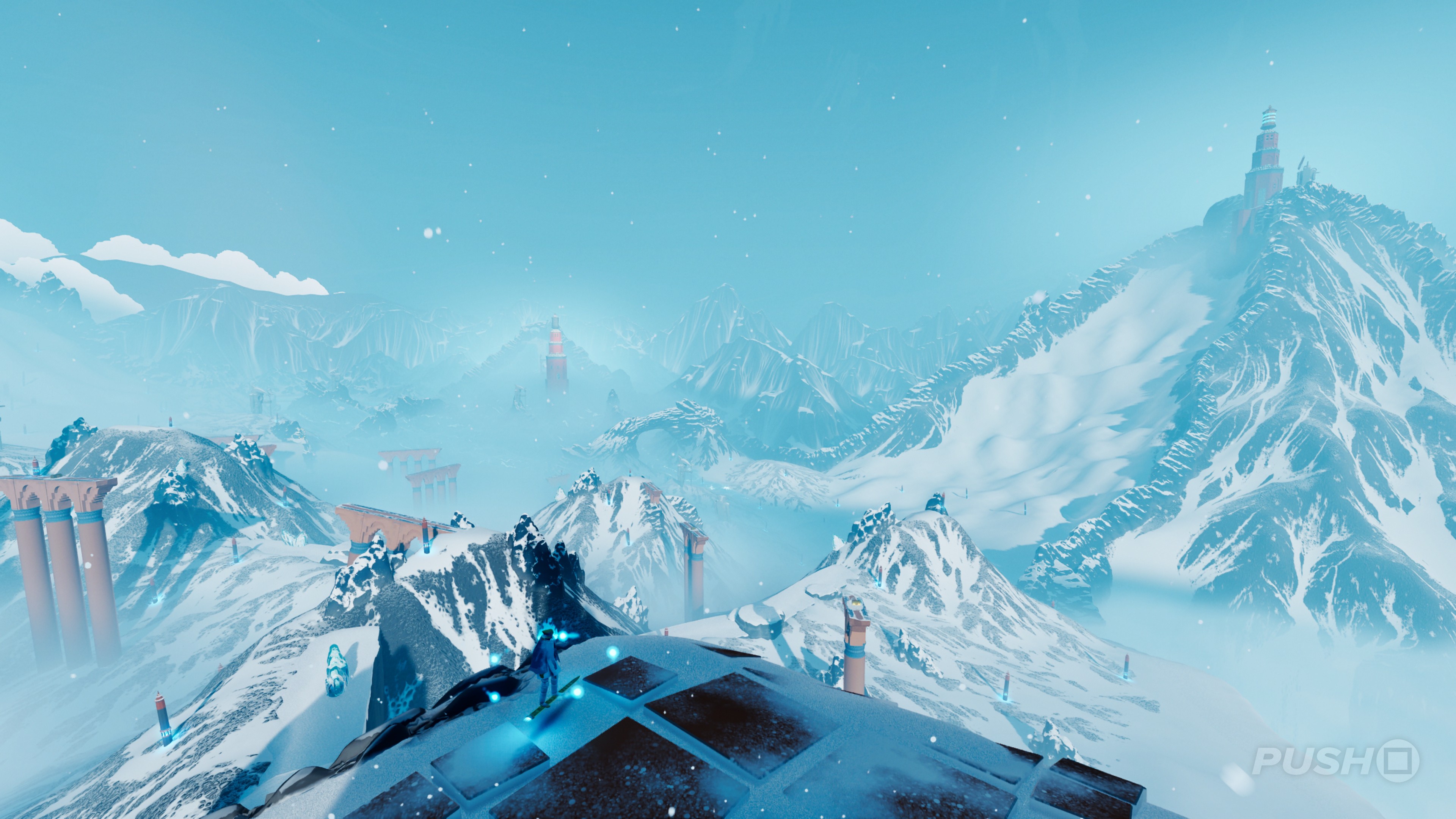
Indeed, as an audio-visual experience alone, this is something quite special. It's a sumptuous release to gawk at, packed with bold colour palettes spread across brilliant art direction.
Meanwhile, a mostly orchestral score from Journey composer Austin Wintory hits the spot on every occasion, with a mix of understated melodies and inspiring swells.
But what really sets Sword of the Sea apart is its use of contrast; the protagonist has the ability to restore water and aquatic life to their barren world, resulting in stunning moments where crystal clear lakes and rivers sprout from the sands, and all kinds of fish start gliding through the air.
Environments start to take on dreamlike, almost surreal atmospheres, and it all just adds to the game's already eye-popping charms.
Once the credits have rolled, you're free to jump straight back into Sword of the Sea thanks to a New Game+ mode, which lets you replay the whole thing with all of your trick-based upgrades intact. It also introduces a few interesting bonuses, including the option to toggle extra HUD elements so that you can see your current speed and technique scores.
Because of its short length, we think this is a game that's well worth replaying at least once. Knowing exactly where you're going on a second or even third run gives the title an even more seamless feel.
Conclusion
Sword of the Sea certainly won't have the same impact that Journey did all those years ago, but in so many ways, it feels like a direct evolution of that legendary experience. It's a beautifully smooth game, set across a series of gorgeous environments that are a joy to explore. While its more game-y elements do feel a tad forced, they're not enough to distract from what is a sumptuous adventure.


Comments 46
If anyone's got any questions about the game or the review, let me know and I'll try to answer them.
As evidenced by the review, I think this is a fantastic game. Highly recommend setting a few hours aside and just blasting through it on a big TV with the volume high.
Excellent. I've been looking forward to this.
@ShogunRok I'm guessing it's not quite as emotionally impactful as Journey and it's effortless grace?
Love the Devs so its a day 1 buy from me.
Interesting-looking game. Good score too. Off topic (sorry), but where’s the Echoes of the End review?
I am only curious about the campaign length.
Was there ever any doubt? I'm glad it's on PS Plus so more people will give it a shot, but I'll happily give my money to this.
@Brundleflies21 Nah, it's not on that level — but then what is? I do think Sword of the Sea comes fairly close to hitting the highs of Journey, though, and that's well worth praising.
Thanks for this review. I'm so glad it continues the traditions from these devs and provides me with more memorable hours to treasure. Given the relatively short length, its a good match to be on PS plus extra and I'm looking forward to downloading tomorrow.
Looks fantastic I would buy it bit I'm skint at the minute because these of the kind of developers that need all the support
@ShogunRok I remember discussing Journey with someone and they asked about my first playthrough. I waxed lyrical about having the same companion who stayed by my side. They raced ahead during the final flight but then waited at the final platform and we joyfully chirped away into the white oblivion. He told the tale that the same happened to him except that his faithful companion disappeared during the climb against the blizzard and never returned, leaving him to take that final flight alone without any feelings other than one of loss.
Nearly broke my heart
@Jammer It releases tomorrow, on the 19th August.
You can buy it by itself, but it's also included as part of this month's PS Plus Extra / Premium subscription.
Was there really any doubt this would be a great game? great review Rob as per.
I’m looking forward to trying this game out. It definitely sounds like a superb game. Great review!
Really looking forward to playing this.
Great! Cant wait to play this 🙂
Will be picking this up
Love a Austin Wintory soundtrack! Thought The Pathless was awesome, so will defo be giving this a go, maybe after I'm finished with Lies of P.
This review makes me so happy - what a great set of games from this dev.
Looking forward to this. I guess the point of the tricks and point-scoring stuff is to give it a bit more replay value, so I'm fine with that side of things
@ShogunRok "Highly recommend setting a few hours aside and just blasting through it on a big TV with the volume high"
This sounds perfect, the game we all need right now.
This looks great! 👍🏼 Time to sub PS+ again
I think I’ll pick this one up. I don’t think I’ll sub to play it. I think I’ll buy it.
I really love Journey and Abzu and i'm happy this game got nice review. I'll put this on my wishlist.
Very excited to check this one out, never got a chance to play Journey.
Didn't read the review as to not spoil myself, just glad that the game is great!! Can't wait to jump in
”Rare frame drops..”. Aren’t you playing on a Pro?
@BennyTheCat Wondered this also, this type of game shouldnt have any drops on any ps5.
@BennyTheCat Isnt it more real to rest it on Hardware that most of the gamers use?
I read with half an eye... nice "free" treat.
I don't have PSP. This looks good but 3h.... how much does it cost, I can't find the price anywhere in your review?
@Dimey its £19.99 on UK store.
@ShogunRok
Hello there, is there a chapter select of some kind once we finish the game we can just play through it, without worry and, then, go for a selective collectathon ? ^^
I never got the fuss about Journey and why everyone praised it despite being a short game with no real gameplay or skill involved. This is the same. More like an interactive screensaver than a game.
@MichaelNau Nah, no chapter select, you just go back to the start of the game.
But on New Game+, you do get to keep your unlocked tricks and your total currency, which lets you continue to unlock things that you may have missed on your first run.
@ShogunRok
Thanks ^^
@ShogunRok Watched the YT video review last night w/ the missus while we were catching up on all the game trailers that look Ike Stellar Blade meets Elden Ring and I was wondering if that was you talking or someone else and was whoever it is just reading this review? While it takes my wife and I a bit to get past the accent, very lovely, she said the talking seemed a bit off, like someone who wasn't comfortable talking into a mic. Though reading this review now I'm thinking maybe it sounded that way b/c someone, you or someone else, wasn't talking, they were reading? Hard to sound natural reading, especially if it's someone else's words, throws off the feeling and the tempo. Thanks.
Game looks interesting, but at only 3 hours I'm not buying it. Not even paying $15 for a month of PS+ Extra like I did when PLucky Squire came out. But it looks good. 👍
3 hours? Behave.
@EfYI agree. It wasn’t a suggestion.
@ShogunRok You can use chapter select after you finish it for the first time.
@MichaelNau Yes you can after you finish the game the first time.
@W0rl0ck
Thanks ^^
Looking really good
This game got me hooked and amazed. I am enjoying every second of it 😍❤️
@Mattock1987 yeah, if you got "interactive screensaver than a game", then it's definitely not for you, man.
Just finished this and absolutely loved it. Only thing is that it kind of ended abruptly.
I would be interested to see the dev try their hands at something less similar to Journey at some point. They certainly have talent!
Show Comments
Leave A Comment
Hold on there, you need to login to post a comment...