
The thing about Housemarque is it makes some of the gamiest games in the AAA space, and that's a gift among big budget titles that play it so safe they start to feel a bit homogenous.
With Returnal, the Finnish studio released the biggest game it had ever made. However, despite a substantial backing from Sony and a stronger focus on narrative, it still felt like a video game you just play because it feels damn good to do so.
Saros is the same. Well, it's the same in some ways. In others, it's very much trying out its own stuff, but the main takeaway is that, if you like Housemarque's gameplay-first sensibilities, this is absolutely a no-brainer.
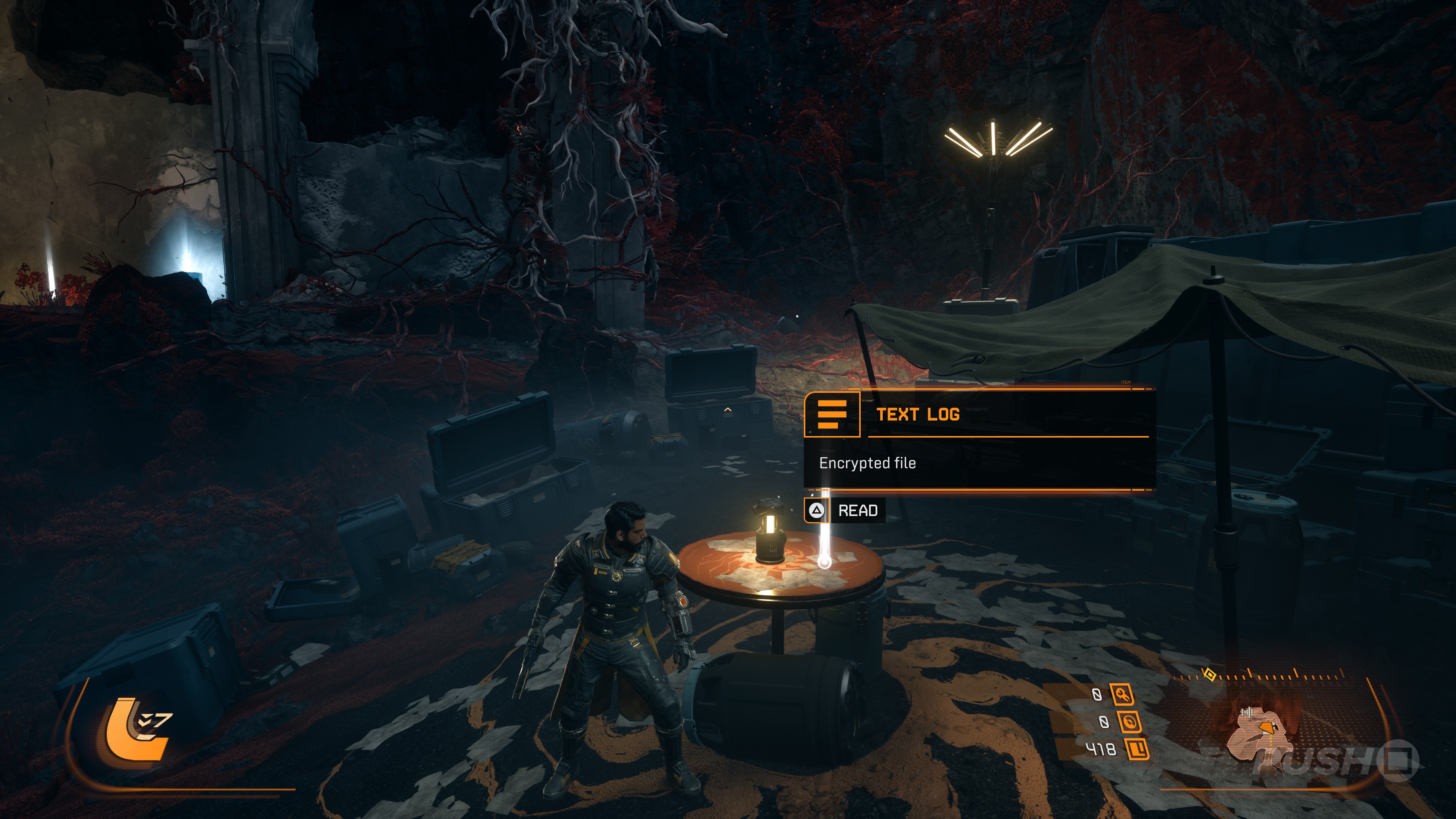
This is a third-person shooter that, in broad strokes, bears a lot of similarities to the team's previous game. Saros is the result of building on what worked in Returnal, and diverting in a few smart ways to deliver a more streamlined, but just as exciting, experience.
It's a run-based shooter, in which you explore the alien world of Carcosa — a strange, shape-shifting planet that's strongly affected by the Eclipse, a regular occurrence that changes the landscape and lifeforms that inhabit it.
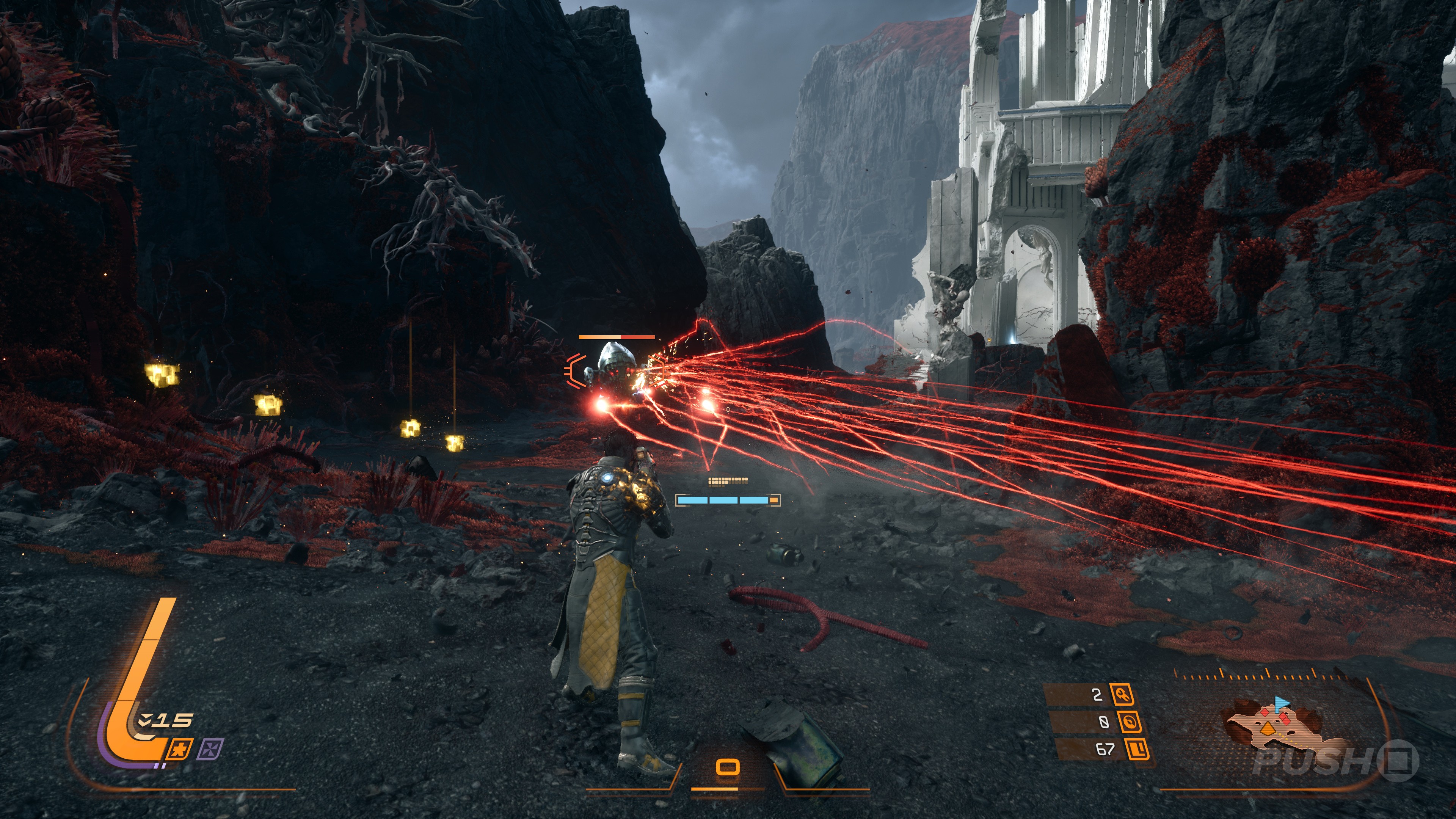
As with any Housemarque game, the action itself is the main draw, and it's fantastic. Movement is smooth and responsive, and combat is deeply intense but, despite the chaos onscreen, it's somehow all readable and intuitive.
Enemies will spawn in groups and fire projectiles of various colours at you, and once you're comfortable with what it all means, you fall into a rhythm of jumping, dashing, parrying, using your shield, and fighting back while you're at it.
Speaking of the shield, it's a great addition that, while it takes a bit of getting used to, complements the rest of your abilities perfectly. Absorbing blue bullets converts them to power, which you can then spend to use a range of power weapons that can really cut through enemies.
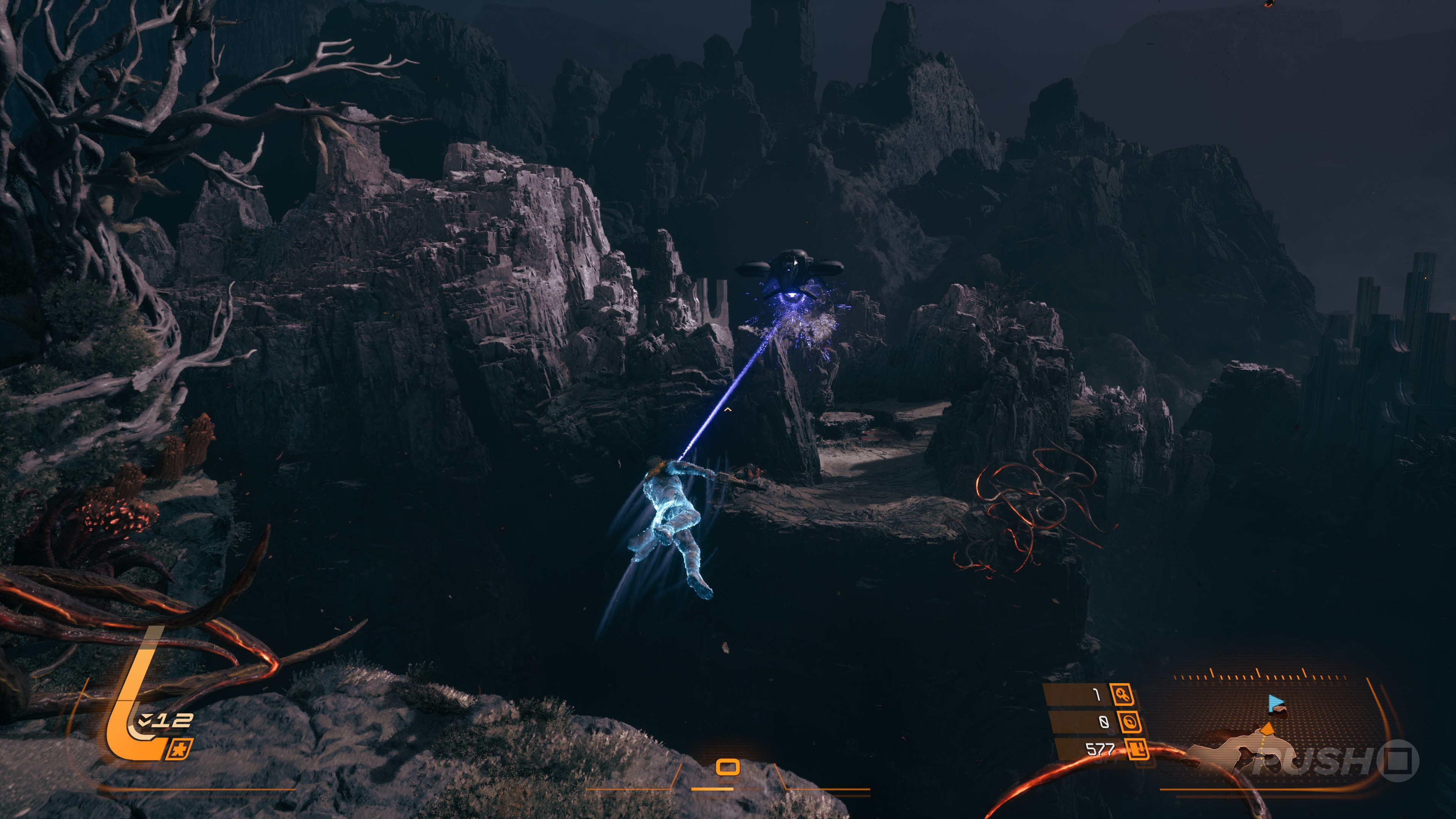
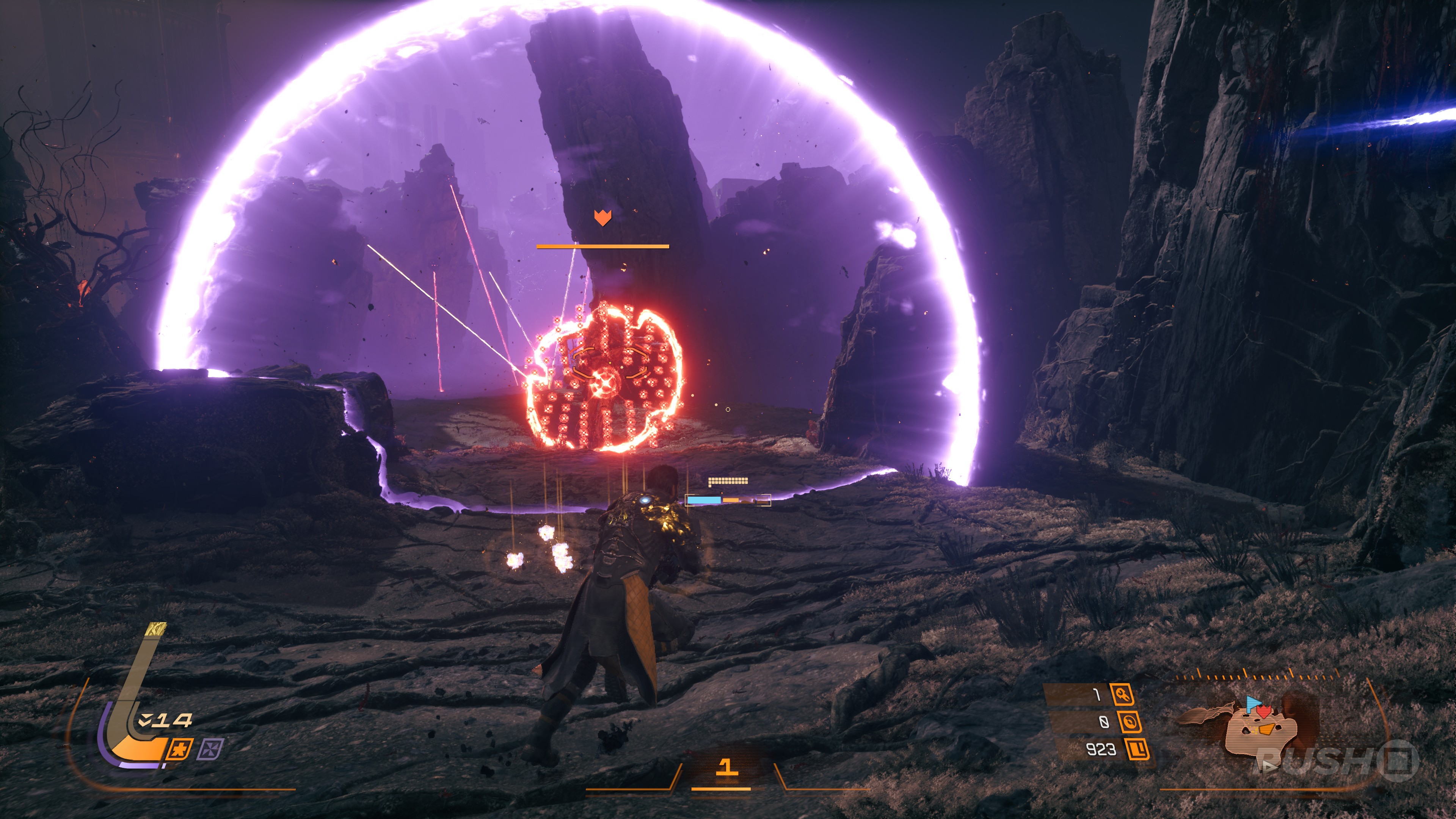
The aforementioned Eclipse isn't just an aesthetic thing — it has a big impact on the game itself. With the Eclipse active, your foes become tougher, environments are more hazardous, and certain attacks inflict Corruption.
Corruption eats away at your max health, leaving you with a shrinking life meter. However, you can cleanse Corruption by using your power weapon, so it's not the end of the world.
Anyway, when it all clicks and you're melting health bars while threading a needle through the madness, it feels superb.
Boss fights are a highlight, as you might expect. We don't want to spoil anything, but there are some excellent battles, especially in the latter half, that really force you to embrace every part of Saros' combat.
Whether to bosses or otherwise, you will die many times, and that's baked into the game's design.
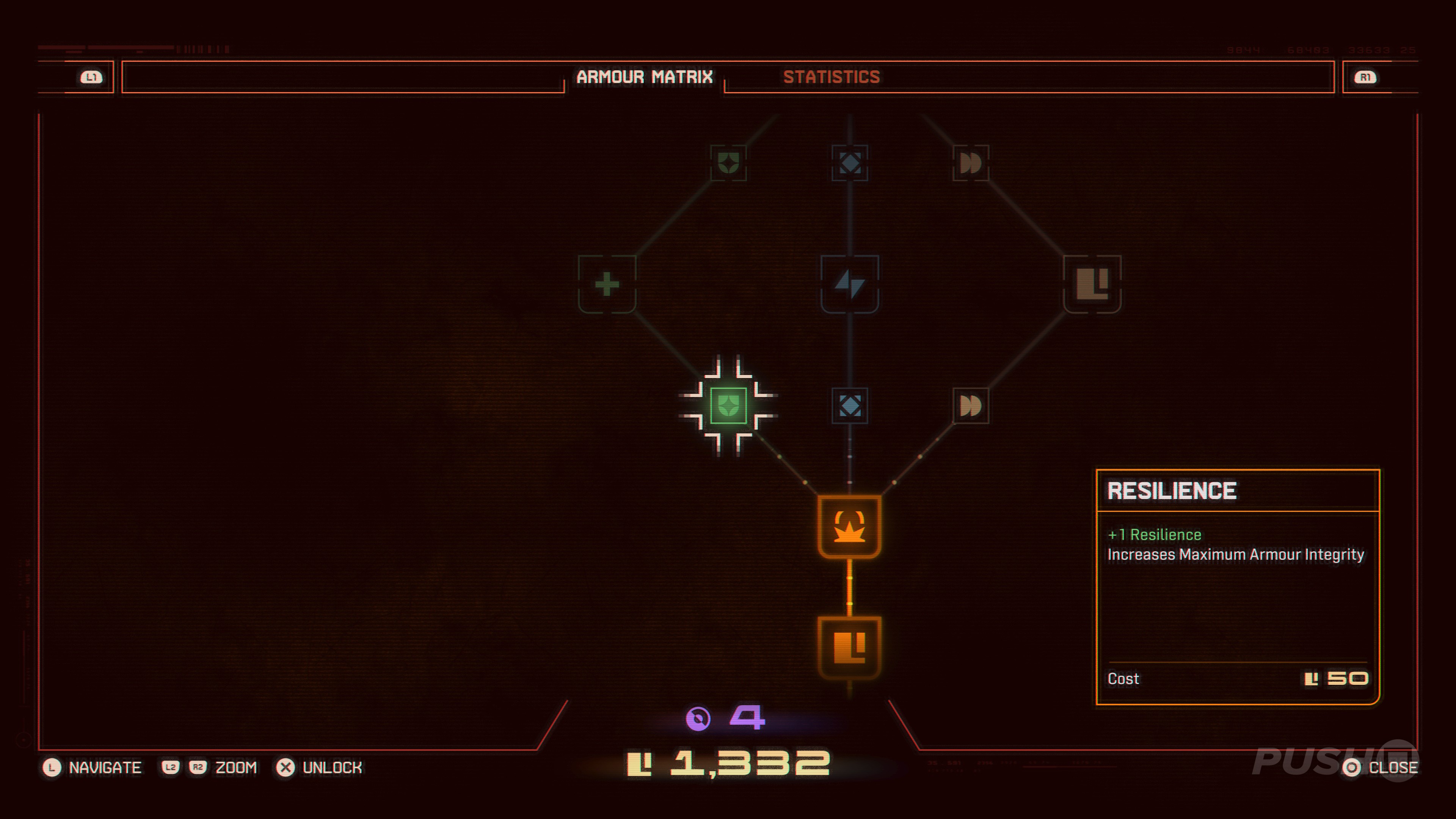
When you inevitably perish, you return to the Passage, a hub where you can chat to other characters and, crucially, unlock a wide range of permanent upgrades.
Using the Lucenite you collect while gunning down aliens en masse, you can purchase all kinds of stat buffs and incremental boosts that mean you'll always go back into the fray that little bit stronger.
It's a compelling loop, and you definitely feel yourself becoming more powerful over time. Returning to earlier biomes that gave you trouble before, only to blitz through with barely a scratch, is always satisfying.
The default balance throughout the game is pretty spot on for our tastes, but a new feature, Carcosan Modifiers, allows you to adjust things in various ways to make things easier or harder.
It's a really clever system; the modifiers you select can make certain aspects more forgiving, but they have to be counterbalanced with negative effects so the level of challenge is maintained. The results can be quite impactful.
For the true masochists out there, you can actually enable as many difficulty-increasing mods as you want. The game can be unbelievably tough if you want it to be — or, you can take the edge off a bit. It's down to you.
Saros is technically a rogue-lite, and while it definitely has some hallmarks of that structure, other elements feel muted.
For example, the layout of each biome is different every time, weapons and other items are randomised, and you're sent back to base on death. However, don't expect to be working towards crazy synergies and overpowered builds.
The shape of each run is largely dictated by the weapon you carry and the Artefacts you collect. Artefacts do imbue various beneficial effects, like making enemies drop more Lucenite, or making healing items more effective, but they're designed in such a way that they'll work with whichever weapon you're using.
This isn't really a criticism; we actually quite like how straightforward Saros is in this regard. By and large, it's concerned with simple forward momentum, and that actually reflects the central character quite nicely.
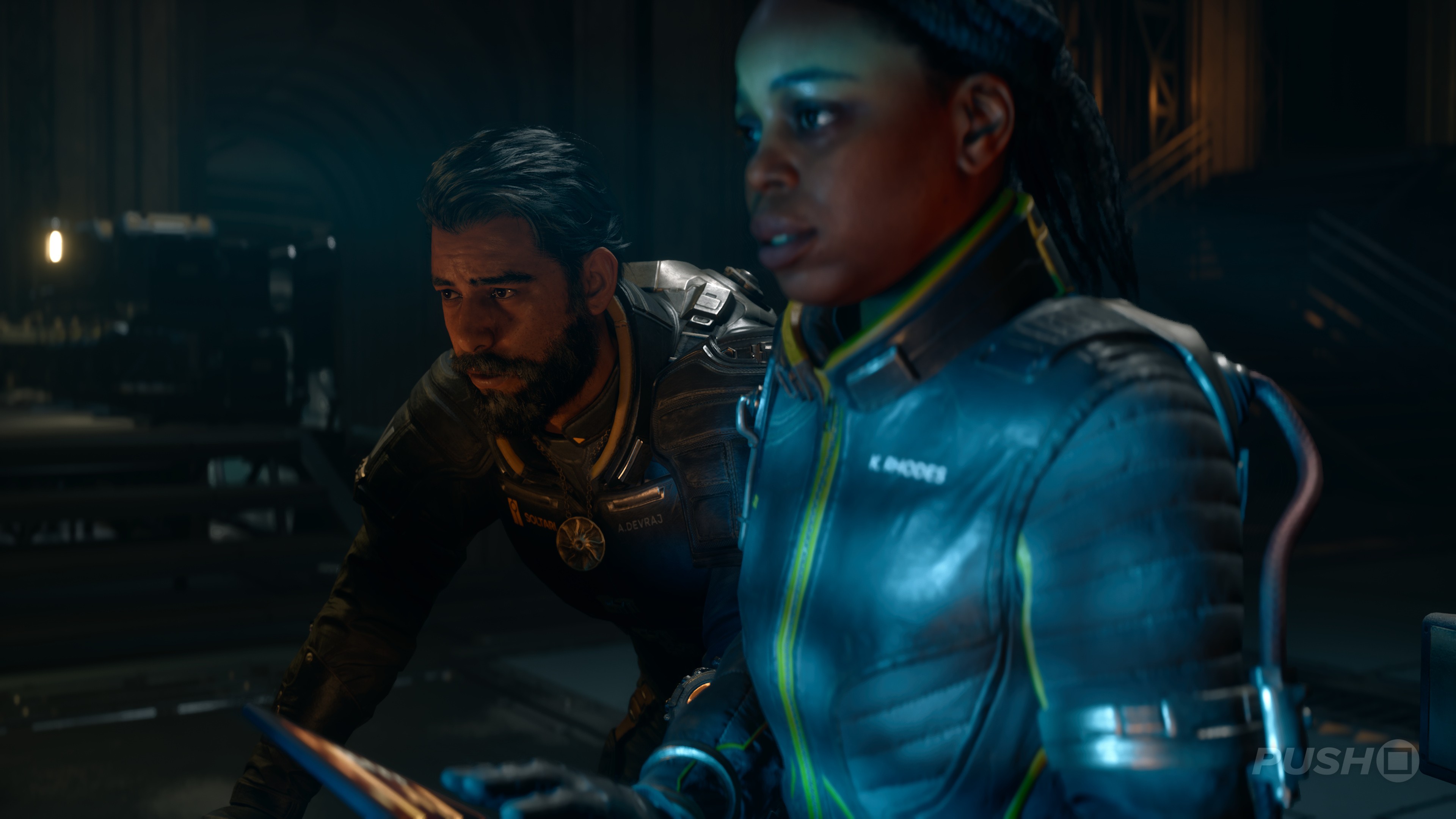
You play as Arjun Devraj, a determined, driven enforcer sent to Carcosa, a planet the Soltari corporation you work for has been attempting to colonise and mine for its resources.
Previous expeditions to the alien world have gone quiet, so Arjun is sent as part of an emergency squad to discover what's going on.
It means your character isn't the only one present; your colleagues usually have something to say to you in the Passage, and it's worth listening to get their perspectives on the wider sci-fi storyline Saros is telling.
While Rahul Kohli steals the show as Arjun, voice work in the wider cast is generally good, and the mystery surrounding Carcosa, and other layers on top, make for an engaging plot.
The visuals are a step above Returnal in many ways, with really strong art direction and environment design doing a lot of work. Character faces outside of cutscenes can look a little subpar, but this is a great-looking game overall.
On a standard PS5, Saros is running at 60 frames-per-second 99 per cent of the time, with only the most minor of hiccups across more than 50 hours of time playing. PS5 Pro, meanwhile, eliminates these rare instances to deliver a perfectly smooth experience.
And if you're wondering whether your DualSense controller will get a workout, worry not — Housemarque gives other first-party teams a run for their money in this department.
Conclusion
Saros is a brilliant third-person shooter that takes what worked in Returnal and streamlines it for an even smoother game without diluting the fun. The core gameplay is the star attraction; complex yet intuitive, and a perfectly judged challenge that's so satisfying to overcome. With compelling permanent progression, flexible ways to modify your experience, and an intriguing story to follow, this is another step towards Housemarque's planetary takeover.


Comments 36
Hey gang, if you have any questions about the game please tag me in and I'll reply asap Thank you for reading.
I will pick this up if it introduces co-op. Loved playing Returnal with my brother and listening to music as we progress.
Would stop the music when we got a boss fight as that was pretty epic. Glad this game seems to be even better!
See you next Friday for an ass whipping Saros
Never doubted them. Tuesday can't some soon enough.
I really (really) struggled with Returnal - couldn’t make it past the first boss (am in my mid-50’s and my reactions are slow, and I get very little time to spend ‘getting gud’ as the kids say. Would like to get this (I’ve got every Housemarque game) but not sure if this will click for me, even with the balance settings.
How close in difficulty would you put this to Returnal?
Didn't read the review (no offence Stephen!), but I'm so happy that it has scored well, (like there was any doubt?) I hope with release of Saros that people start to take notice of Hoursemarque (all their games are bangers tbf). I have Friday booked off to play this!
Edit: 92 on Opencritic I could cry tears of joy right now
Lifting review embargo a week before release is a flex. Well done to the devs
They must be pretty confident letting the reviews come out so early. Seems like a good call.
very unusual to see a 9 score from push square this means the game is great!
I have to play less marathon once this game come out.
Just pre-ordered the digital deluxe. Knew I wanted it but an 89 on MC and 92/93 on OC cemented the need to get those suits.
@Contimaloris Pretty standard for Sony releases.
Well done Housemarque! =D
@Jayphex similar issues here.
Their lack of respect for my precious time, and those who had a busy life, and are subject to shorter play sessions that may need to end sooner than expected when we picked up the pad, has poisoned their brand in my eyes.
They made wholly unnecessary design choices that greatly restricted accessibility for "normal" lifestyles, for no good reason.
I've seen many who loved the game and who, with the greatest respect, had no life, be critical of those choices.
Good returnal sequel.
@Contimaloris Yotei was the same too by the way.
@Quintumply hi Stephen, great review! I had a quick question - as someone who loved the difficulty in Returnal, one of the features that has given me slight concern is the ability to begin your run in any biome you want. How did you find this? Did you still find incentive in starting your runs at the beginning or did you always start in the latest biome?
@Dogbreath Not everything is made for everyone. Should Football be made more simple because i health issues that make doing a sport like Football near impossible? If you don't have the time for something like Returnal well that's on you and obviously the game wasn't made for you in mind. Its just entitlement to expect everything to cater to your needs.
Expected as much, though I imagine I won’t love it the way I do Returnal. Still looking forward to picking it up. Just after i Platinum Crimson Desert, so maybe a bit down the road at this point, but definitely next in line.
@DennisReynolds In later patches they made it a little bit more forgiven, but yes I have agree with you, they shouldn't have to pander to people who the game wasn't aimed at.
Of course it's a 9/10. Housemarque never misses and it looks like they're delivering a highly polished, finished product.
I hope Saros and Housemarque get all the recognition they deserve.
A thorough, well written review which like all the other reviews popping up is telling this longtime Housemarque fan exactly what he hoped to hear.
Thanks to Pragmata and Hades 2 April has been a phenomenal month for games and Saros looks to finish the month strong.
This has been a great few months for gaming.
PSSR2 has been a total success for Sony; is capable of upgrading at the system level, which is encouraging me to replay some old favourites.
Capcom have been on the very top of their game, and now this game from Sony, which even though I am not into roguelikes does sound very enticing.
@Miles_Edgeworth Hi, thank you for reading So yes, you can teleport immediately from the hub to any biome you've unlocked. I used this a lot to get back to certain areas a bit faster and keep pushing forward, and I think it's a really good addition that prevents those super long run-backs.
However, there is incentive to begin your run earlier, because if you get to your latest biome by running through previous zones, you will be much stronger than if you simply teleport there.
That's not to say teleporting is useless, you can still succeed by doing that, but you obviously build up Arjun a lot more the longer your run goes on.
The best thing really is that it's a very flexible game in terms of challenge — you can teleport or not, you can use the modifiers or not (or just apply the ones that make the game harder as there's no upper limit on this). It can be as difficult (or forgiving) as you want!
>big budget titles that play it so safe they start to feel a bit homogenous
Will you remember your own words when Sony's another AAA "deep cinematic experience" comes?
Nice review. I'm glad Housemarque continue their positive streaks 👏. Hopefully this will lead to good sales numbers too.
@Dogbreath Should horror games and movies removes all the jump scare, creepy monsters / ghost, blood, or tense atmosphere just to cater to people who doesn't like horror?
Should spicy foods stop being spicy to cater people who doesn't like spicy?
It's not the devs didn't respect your "precious times and busy life", they just don't cater to people like you who's very busy saving the world, making money for yourself / family, or whatever irl activities that block you to spend just 1-2 hours in the weekend to play video games.
@DennisReynolds oh cmon man, that is the old chestnut excuse for that type of ZX spectrum era game design.
I could design a car with a seat where you cannot reach the pedals unless you are at least 5 foot 7, and then use the frankly laughable excuse that "it’s not for everyone".
When in reality anyone with two brain cells could’ve fitted an adjustable seat.
The design choices in Returnal were deliberately restrictive and unnecessary.
Only bad players believe that having an abundance of free time is the equivalent of having skill.
Design choices that challenge one’s abundance of freetime, and how worthless and sacrificeable ones free time is, instead of one’s skill, do not add anything to the game other than to deliberately reduce accessibility.
@AnginaPectoris yeah I'm sure they'll sort out most of the performance dips. Then they can get a 10.
It just looks too similar to Returnal. Think I’ll skip it.
Normally I don't like roguelikes, but this game looks great!
@Dalamar Starting to wonder if you actually like any game...
When there's only two cons and one of them is complaining about the characters faces, you know the game is good!
@Oram77 pretty certain this guy hates anything that's western and not perverted.
@Dalamar are you sad to see another western game review so well?
@Quintumply thank you so much for such an in depth reply, that’s all really great to hear and sounds like exactly what I’d hoped for! Can’t wait for it
@Dogbreath You know they added a suspend and resume feature not long after launch right?
You just want something to cater your needs. Well that's not how it works. A game made for everyone is a game for no one. You keep talking about "free time" well again that's your problem. Don't like it don't play it its really that simple. Also i think the issue here is less this lack of "free time" for you and more a skill issue but rather admit that you would blame the devs/game, when Returnal launched i had very little free time and well i got by just fine it just took me a little bit longer then most.
Show Comments
Leave A Comment
Hold on there, you need to login to post a comment...