 review by
Over the last few weeks, my friends and I have been taking part in what has been dubbed “Big Walk Mondays”. Together, we’ve taken to the Australian outback-inspired setting of House House’s latest adventure, and to say it’s been the biggest multiplayer surprise of 2026 is an understatement.
Big Walk is strictly a co-op game, playable by as few as two players and up to 12 players, with proximity chat being a huge pillar of the game’s design. With that in mind, I reckon many people will be turned off by Big Walk, especially if you don’t have a dedicated squad to play it with. However, in a really cool feature, the puzzles and island dynamically scale to your group size, so it isn't made with one group size in mind.
In my case, I jumped into the game with three other friends, and Big Walk just sort of leaves you to it. Spawning into a hub area, you get some tutorials detailing how you interact with items and how you move your arms, which can be pointed forward, upwards, and to the side.
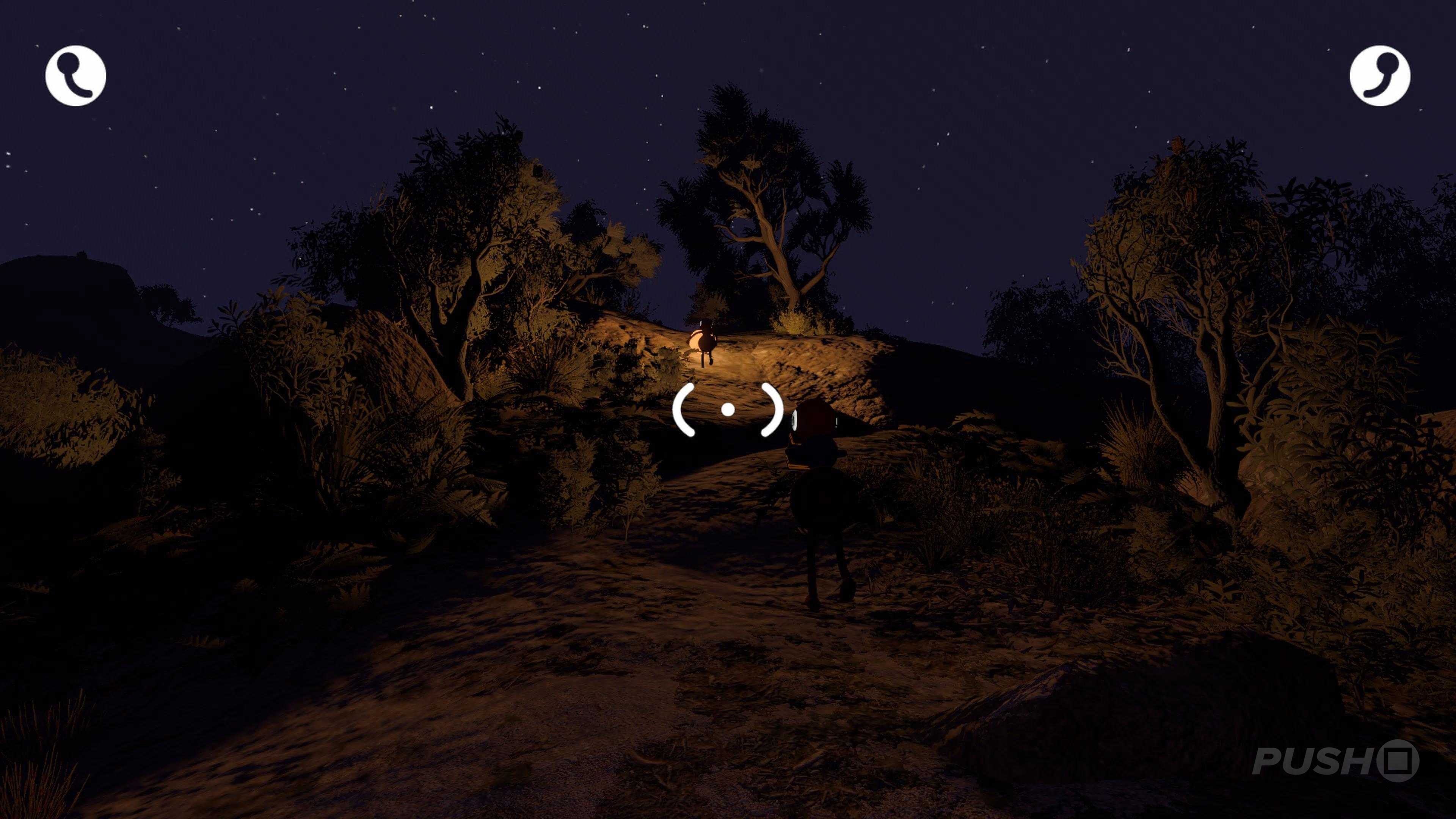
You take on the form of characters I can only really describe as “funny little guys”. Made up of several balls, they are just amusing to see move around, amped all the more by the hilarious way that the nose throbs as you talk.
You’re then set loose in an open world with no objective – you must simply explore. This hands-off approach to Big Walk is its greatest strength. Within a few minutes of leaving the base, a structure on the horizon caught our attention. It was here we were able to customise our appearance, so we quickly knew who was who.
Then we noticed a platform, which had a button on it. When pressed, a box lit up a few hundred metres away. Someone had to stay behind to hold the button, while the other went to the box. Inside was some kind of pear-shaped object, which at this point, we had no idea what to do with.

It wasn’t long before we found another platform with a handy pear-shaped slot, and quickly we understood that we must collect these to gain access to a key. That key then unlocked a bridge which took us to a whole other area.
I’m detailing all of this because that initial hour is basically the structure of Big Walk. You see something, you explore it, it usually has some kind of puzzle to unlock the pears which then unlock a new area.
It’s not telling you where to go, but the natural design of the environment evokes a seamless sense of discovery. You’re discovering how the game works in real-time with no text tutorials or glowing markers.
That design philosophy is exactly why I ended up loving this game so much because not only does it hold onto that philosophy through its entire run, it also steadily becomes more complex as you learn it.
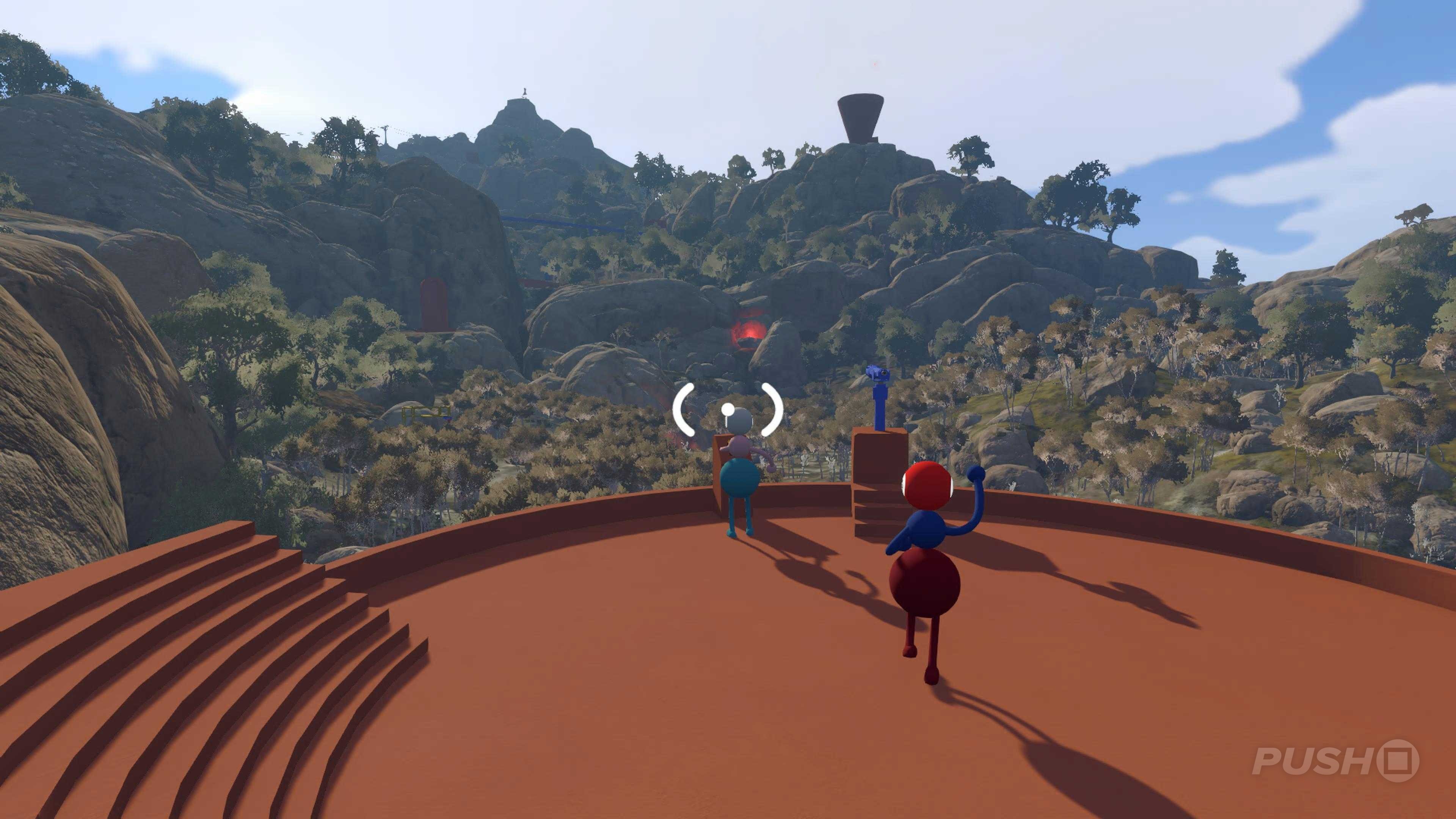
In the first few hours, we were learning to hold buttons at the same time or make towers of our funny little guys to reach high-up objects. A handful of hours later, we were devising how to communicate through gesturing when separated by soundproof glass.
The puzzles have such a great variety to them. Some of them are all about talking to each other; others are about physically coordinating to overcome physical obstacles.
One puzzle saw us all separated into different rooms. We all could see one symbol of a four-symbol code, and needed the others to inform us what the rest of the sequence was via a teleprompter.
The issue was that the person in the first room could only speak to the person in the second room, and they could only talk to the person in the third room, and so on. It sounds simple enough now, but in practice we were constantly having to reconvene to discuss who was getting it wrong and how to solve the issue.
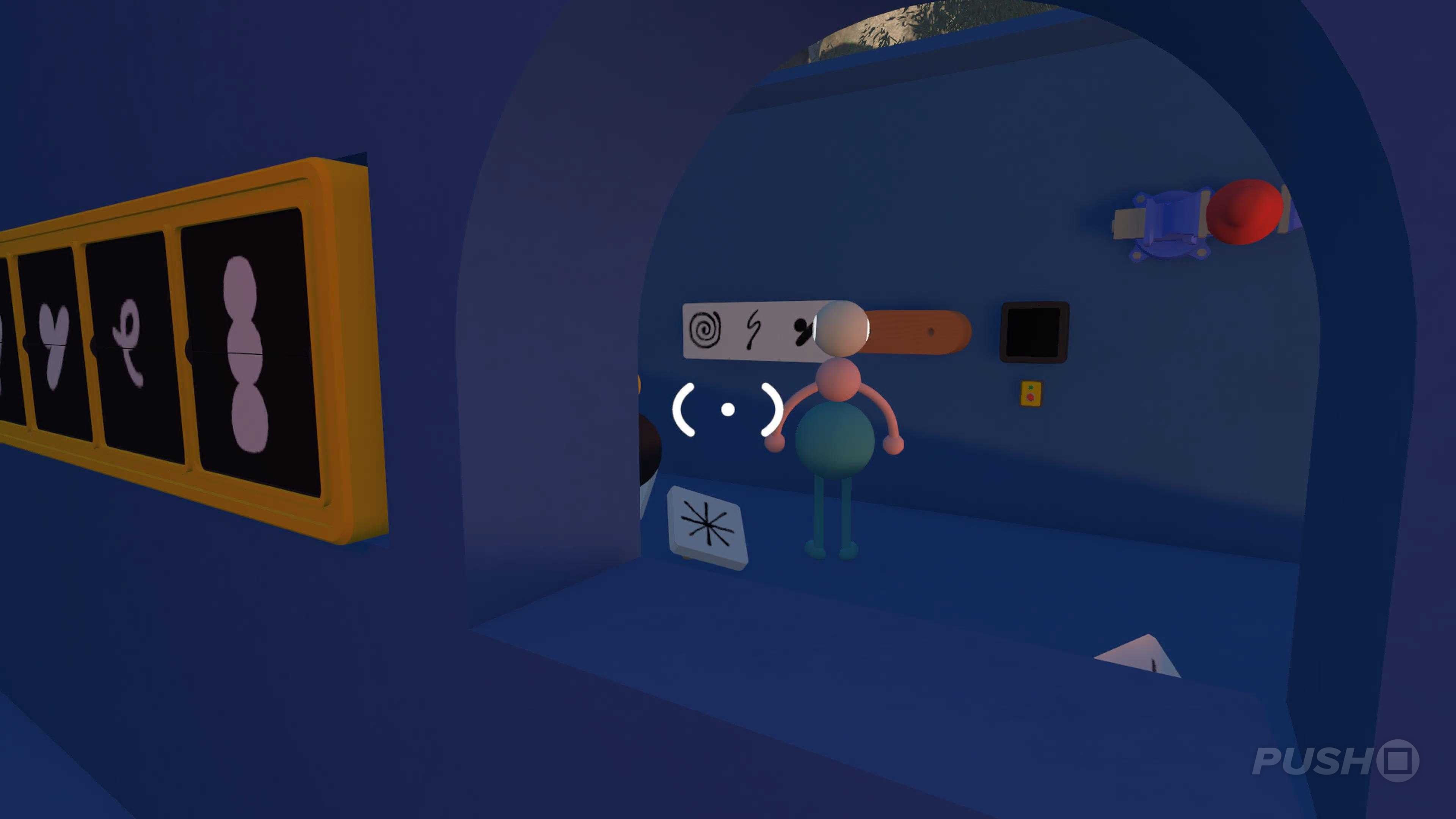
Those are some of my favourite moments in the game. Big Walk often forces you to take a moment and devise a plan with one another, and it regularly leads to some hilarious debates. We would often get into arguments over how a problem should be approached and why one person’s plan was better than the others.
That ingenious design to its puzzles is really solidified by the game’s commitment to immersive mechanics.
As I’ve mentioned, proximity chat means you cannot speak to each other from more than a handful of metres away. There’s a brilliant use of dynamic spatial audio, where our commands or cries for help realistically react to the space that we’re in. We had a good bit of fun when we realised our shouts echoed across the valley from a vantage point.
Then there is the day and night cycle, which genuinely plunges you into complete darkness. If stuck in the outback at night, someone needs to physically carry either the glow-globes that are dotted around the map, or a torch which can be found in certain locations.

Each item needs to be carried by a person, which often leads to some funny scenarios since every item can be kicked away. One time I kicked a key off a tower as a joke, and we spent around 15 minutes scouring the woodlands below looking for it. I quickly learned not to do that again.
That sense of physicality then feeds into Big Walk’s version of progression. As you explore, you’ll often find tools like laser pointers, the aforementioned torch, or even a physical map.
Transporting these to and from puzzles is really your biggest challenge, as someone needs to carry each object. But eventually, we discovered that blue structures typically held some kind of backpack or utility belt. It felt like a supreme upgrade when we discovered a backpack attachment that allowed someone to carry two pears at once.
You’ll also discover shortcuts back to the base, which acts as the starting point for each session. Steadily, you become more aware of what each kind of structure means, what they can unlock, where to take them to, and even how to traverse space quicker as you unlock things like monorails and ski lifts.

It’s fascinating that the game never tells you anything other than how to move your arms, yet you learn so much about it through natural discovery and teamwork. It genuinely started to feel like “Big Walk Mondays” were a bonding exercise as well as a really fun puzzler.
My biggest issue with the game was really down to performance. The game looks quite nice, but often struggled with a tanking frame rate, especially on the base PS5. This is less of an issue on the PS5 Pro – even though there isn’t official PS5 Pro support – but you’ll still get the odd dip in larger areas. At the time of review, the game has now been out for a month, so it’s disappointing to see that this issue still hasn’t been addressed.
Conclusion
Big Walk is a quiet yet genius co-op experience. It sets you up with a fun interactive team-based system and just leaves you to uncover its wonders. The sense of discovery is palpable, and I was often blown away by the game's sense of scale and how it implemented progression in a seamless yet meaningful way. If you and your mates are looking for your next co-op fix, this is something special and unlike anything else out there.


Comments 36
No single player, no buy
Fantastic game.
Whoever made it must have grown up watching Crystal Maze.
I've been playing it every Sunday with my friends. I'm completely hooked. It's such a chill time.
Removed - inappropriate; user is banned
Removed - discussing moderation; user is banned
@Ravix You got your Nine. For some reason I thought I already read a review for this game weeks ago. It really does look and sound wonderful and I did jump in solo for a look around. I'm glad that games like this can be made and are being made. The world and gaming itself would be a little less exciting without them.
@Shepherd_Tallon Time for me to Youtube Crystal Maze, you sparked my curiosity. Edit: It looks great, downloading the entire series as we speak. It says 1990 to 1995, so I'm assuming it's the right one.
@The Darts That's the one, and I envy your childhood. The Playstation One, PS2, literally every Ninities movie, and I have 'you don't own anything', game leaks, Developers losing their jobs, studios closing. But at the same time there are games being made like The Big Walk, leaps in technology, self publishing. I'll pop an episode on while I clear some enemy camps.
@GirlVersusGame watch the Richard O'Brien version and not the more recent Richard Aoyade version, and then go and do it for real at a location near you 😁
Ummm....I didn't discuss moderation.
Anyway, like I said, I'm too immature to take the name Big Walk seriously without thinking about a certain Big Train sketch.
Me and my nephew got the platinum and loved it.
This was probably the best multiplayer experience I've ever had in gaming. So much fun. My only valid complaint (on PC) was that there isn't more of it. My friends on base PS5 did report performance issues too though.
@GirlVersusGame they made Goose Game. It was never in doubt. Honk! 🪿
Such a brilliant game this. Totally not something I’d have thought to have been my thing but I absolutely loved it. More of this please!
@GirlVersusGame my thanks. My childhood was WAY better than that. I was around at the start of gaming in the 70s and have grown up alongside and in tandem with the hobby. That's why I can tell you despite the wonders of the games we play now on consoles far, far superior to what came before, we've left the golden age of gaming far behind. The 90s was the pinnacle, the Amiga 500 the greatest machine ever devised, Crash and Zzap 64 the best magazines (websites are absolute crap journalism compared), and Knight Lore and Sensible World of Soccer or Cannon Fodder the best games ever made 😁
@TheDarts I've only gone as far back as The Master System, recently was the first Sonic, Bonanza Brothers (which I really liked and played again on the PS4 Collection) I'm working my way through The Mega-Drive at the moment (Taz Escapes From Mars yesterday) some of the SNES too with Alien 3 (which is impossible) Terminator 2 Arcade (which is almost impossible) Looney Tunes which is great, SuperStar Wars (which is possible but hard)
I rotate for the history. I've been reading the Official Playstation Magazine too and the in the first Tomb Raider one there's a competition for who can market the game better, one guy a tattoo, another named a boat after the game. The biggest problem are the Demo Discs, I pop them in to make sure they are working and end up playing the whole Demo, or worse the whole game. I've sorted just over Seventy'ish, from the original Demo 1's (every region) Then the Seasonal Collection to the magazines. Not much PS5 gets played.
Those are all Demos I'm sorting/playing. My introduction to Metal Gear Solid was that Japanese Demo.
I'm not sure about any systems before that, I do collect some movie licensed ones, really big boxed ones with cassettes and posters, chunky manuals too. For a time I tried Arcade Cabinets too, everyone said 'kat you need Killer Instinct', so I did and realized I was useless at it, the game boards are huge and cut your fingers, people pirate refurbished boards so you can't really tell an original from a copy. It was a brief experiment, I was trying to preserve inventory from an Arcade at the time.
People offline don't get it, none of those things are from my time but neither are my movies, or music so it makes sense that games join in that eccentricity. I think toys are next, I just started with Kenner's movie toys like Aliens. I considered cassettes too and already put some movie soundtracks aside. There's just so many fun and interesting things from back then. I can't look at Netflix thumbnails all day and these things, it feels too sterile and soulless.
Cassettes because I recently opened one and saw they fold-out, they contain art/stills and even lyrics. It's amazing.
I wish I had the sort of friends that would want to actually play this. Think the last time I did anything like this was Portal 2’s multiplayer.
I’ve been trying to play this one, but games like this make me realize I just don’t have a friend group for this kind of thing. My friends only want to shoot things when we play in a group setting. I’d get the game for my family, but, even though the game’s on the cheaper end, buying a game twice for two different platforms just to play it feels a little like a hurdle to me too, especially knowing that some of the puzzles rely on gamechat challenges. You defeat that when you’re playing next to each other on PS5 and Switch 2.
Is it sad if I wish there were AI bots to talk to?
@TheDarts oh man! Sensible World of Soccer and Cannon Fodder! Absolutely amazing! I read those magazines too, along with Commodore User!
@AaronBayne how does the game work when you log out and then log back in and one of your friends can't make it, does it continue on with the same save game, minus your friend, so they can continue when they rejoin, but having missed some puzzles? Or does it load up a completely new game where it changes the size of the island because you now don't have the same number of friends?
@GirlVersusGame fantastic! I wish you could've been there during the heyday of Arcades in the back of mini-cab offices, full of cigarette smoke and kids from schools all over the borough playing Decathlon gripping 10 pence pieces bashing buttons to run faster. But to see you trying to appreciate what came before....truly heartwarming and inspiring. We need more of this!! Forgetting history is where all our problems stem from. Keep it up! You've made my day.
@Bingbongboyo Basically, any save will have a host, and it's up to them to come back to the game each session. If your host can't make it, you need to start a new save, but if another member of the party (not the host) can't make it that session, then you can continue on the same.
So we essentially picked the person who was most likely to be online every time we played to be the host. Hope that makes sense!
@AaronBayne yes it does! Thank you for clarifying. Makes me want to pick up this game to break up the Walkabout Golf we always play!
@Ravix I did play it, loved and still hear thank honk when I see the game. I call it British Goat Simulator, it kind of is.
I love this game.
Unfortunately, I feel like the review gives away a bit too much.
Honestly, this is a relaxing, coop puzzle game. Aside from that, I think it is great and you ABSOLUTELY SHOULD NOT communicate outside of the game.
Other than that... go in blind and have fun!
Removed - unconstructive feedback
Been playing this with my ex (also best mate) near every weekend and absolutely loving our "long walk' where we suddenly realise we're a good few hours in.
What you call pears, i started calling "jellies" and it stuck. Now and again we have "cheated" ss we chat on party as well, but even with that, some things are still a bit difficult.
It is an exceptional multilayer puzzle game though.
We're at the "end game" now and will probably take 1 or 2 more days to finish (need 4 jellies), but again, i cannot recommend it enough, even if you "cheat", as it still creates conversation and logical thinking, even when not playing as intended.
Well done house house for this. It's my game of the year so far, due to it genuinely being something new.
@TheDarts don't forget ed tudor pole from the 2nd iteration of the pistols - he qas a good host (though not as good as R O'B) too!
GOTY so far for me. I found a random lobby on Reddit and played it from start to finish with a bunch of strangers. Had an absolute blast and even got the platinum.
@GirlVersusGame yeah, the good old days of cassettes and cds with "books" that had lyrics and credits and more artwork. I used to love them as a kid. Its how I learnt new words and all the lyrics to songs as a child. Its thanks to those books I learnt words no 10 year old should have known (good and bad!) thanks to The Smiths, Queen, Skid Row etc.
It truly was a great time to grow up. Even some old vinyls (like Elton John's self titled "black" album that i have) has all the lyrics in the gatefold, and "cosmic wheels" by Donovan in 1973 has a colour in "psychadellic"-style picture that you do yourself.
Physical media is ace!
@somnambulance your welcome to add me and play games if wver we find something mutual! Im always up for "relaxing" game experiences online!
@Vladspartan don't know who soby is, but 9/10 is a good for for a good game.
If you actually play it, you'll see why you can't have public matchmaking. It's very obvious and someone has already explained it.
If you had public in this and joined a random game you'd have even less of an idea what to do and either you'd be lost, or aggravate the others in the session, so feel free to think its a 4/10 game.
Maybe find at least 1 person and play it. Though the fact you'd happily mark something down the equivalent of 50% of a maximum score because of one thing that it essentially requires makes me wonder what type of games you do play, as it surely can't be this type of thing?...
***edit*** it was also free on plus, so hardly marketing either way.
@Slideaway1983 The Smiths I found through Pretty in Pink (1986) Queen Through Highlander and Skid Row through The Prophecy (1995, Christopher Walken movie) most of my music and my English came from and started with soundtracks. I can trace almost every band to one. Donovan too that was Sleepers (1996) and Elton John was probably The Lion King followed by Nikita, the latter being more relatable. Recently someone introduced me to RUSH on here, they wrote a full-page essay on the band, their music, it's great to get a taste of that passion. I'll try Cosmic Wheels, thank you.
Edit: I'm listening, they sound like Bowie with a little Cockney Rebel. I'll listen to pretty much anything but I really like Bowie. The Smiths too actually, I saw Morrissey live once, saw my first gay kiss there too, it was eye opening. I was told not to stare, it was during There is a Light, two men, I'd never seen that happen before. I never forgot it, they looked very happy, it gave for me a new meaning to the song. Edit: Done and dusted, I knew Earth Sign Man and Only The Blues.
Fantastic to see more vibrant and fun games as a much needed change from the drab "you are the hero of this dark story" games we are currently infested with.
Been watching this, can't wait to try it
This game has been my personal highlight of 2026. It’s such a straightforward concept but executed so well. The Studio deserve all their praise. Phenomenal game, you can comfortably play with two people but three or four is really a lot of fun.
@somnambulance AI would be bit sad yeah. The entire premise is walking and talking. Human connection. There are loads, like boatloads of people looking for groups. It’s not a game you need to rush but you’ll definitely be a bit sad when it’s over.
It’s engaging, satisfying and hilarious. I finally managed to play with some close friends who I haven’t gamed with in years and don’t think I have ever laughed that much in a MP game. We have fumbled our way through the first couple of hours and I can’t wait to pick it up again with them over the weekend.
@GirlVersusGame great you listened to it- did you enjoy it, even though uou knew a couple? Got to be honest all my "old" vinyls are hand me downs but luckily I love classic rock (as an overarching descriptor) and lived all these albums.
Dr John's album Gris Gris I loved as well. Swamp blues and psychedelia - also realised that they did "walk on guilded splinters" on that album that Paul Weller covered and loved that song anyway. Then i went down a rabbit hole and realised Johnny Jenkins did it as well!
Cool on Morrisey, though hes a bit "marmite" here in the uk due to his outspokeness (love him or hate him!) And as for bowie; I'm going to the v and a exhibit sometime before Xmas with my ex as she's a massive fan. I like ziggy, and thats all I need 🤣
@Slideaway1983 great you listened to it- did you enjoy it, even though uou knew a couple?
This is what I mean, those are my Summer listening stats. Someone told me they probably didn't listen to that much in their lifetime, I play music too, piano and cello. I love everything about music, love learning people's tastes, finding new genres. I'll listen to pretty much anything once, in the case of the album you mentioned? That was three times and I really liked it. Then ended up listening to more Bowie and other bands and artists from the time. Dr John's album Gris Gris, I know this one too. I found him through The Princess and the Frog, Down in New Orleans was his work.
I never heard the term a marmite before but I like it, so I'll steal it and use it at the right opportune moment. I understand the meaning though because some people swear by it, others say it's horrible. For me I prefer his earlier work with The Smiths. He had less to say as part of a group than he did solo and sometimes a person doesn't need to talk, just sing. For me personally I prefer to listen than to talk. I can learn more about a person by their taste in music than any other medium, hobby or interest. I've always seen it as a kind of universal language. Accessible to everyone, but it means something different to each listener because they feel it, not just hear it.
@GirlVersusGame I'm guessing your probably younger than me as I was like that a lot as a teen up to my mid 30s. For context, I used to have a drinking "problem" allong with severe depression and spent all day playing games and listening ro music - not saying that's your problem! - but I lost the passion for listening so much, unfortunately. When I do I'll happily throw Spotify on a random playlist and when I find songs I like, I try and remember to add them to my favourite list - which is now about 4,000 songs strong. I still find it hard to believe that playlist badically started from a lonely boy that fancied a girl that liked oasis and my personal love of music was born (ofc, I also listened to classic stuff as my step dad was a rolling stones / motor head/ hawkwind fan, and my mom was sweet, bay city rollers, t rex and John lennon, so a lot of cross pollination occured naturally!).
I like to pretend I play - i tried an online grading system and (granted its bot impressive) only made grade 1 on piano, as they kept marking me down for positioning, even though timing and keys were correct so I got annoyed and gave up, I basically Platinumed rocksmith on keys and bass and I have a shed load of synths as well, so I have a lot of gear, but no idea, as we say 🤣🤣
As for marmite, I felt I had to explain it just in case, as im pretty sure I recall you not being from the UK, so thought best to clarify; but your welcome to use it, ofc!
The smiths were great, tbh, and he said what he needed to say in the songs, then he went solo and thought he actually had opinions that people wanted in a non entertainment form. Some people lap it up, most of us can't abide it - though i will say even though it was around the time he lost favour with most fans in the UK, Irish blood, English heart was a great album (and somewhat poignant to me, as my grandad was Irish, and I was born in England!).
And I sort of agree with the sentiment that you can tell a person by the music. You can tell the soul of the person; are they insecure, depressed, a bit of in introvert / extrovert by what they listen to. Given my taste in music, it probably encapsulates me well, as mentally I'm all over the place anyway 🤣🤣🤣
And feeling the music i was having a discussion (that the other person decided was an argument) on reddit yesterday about new oasis music in that they didnt want it as it wouldnt be any good. I argued whether its any good or not is subjective, and its down to the artist to decide what to provide - and indeed whatever they provide will never please everyone, due to the subjective nature of the topic.
Its not like they're inventing a wheel or bread knife- some life changing object that benefits humanity. Like any art, it always will only benefit a small proportion of society, and even the die hards may not like it, but it is still a piece of work hand crafted by the artist.
If it triggers an emotion in one single person that isnt the writer/ composer/ painter etc, then it has done its job.
Show Comments
Leave A Comment
Hold on there, you need to login to post a comment...